
Waste Coupling for Kitchen Sink: Types, Sizes & Materials
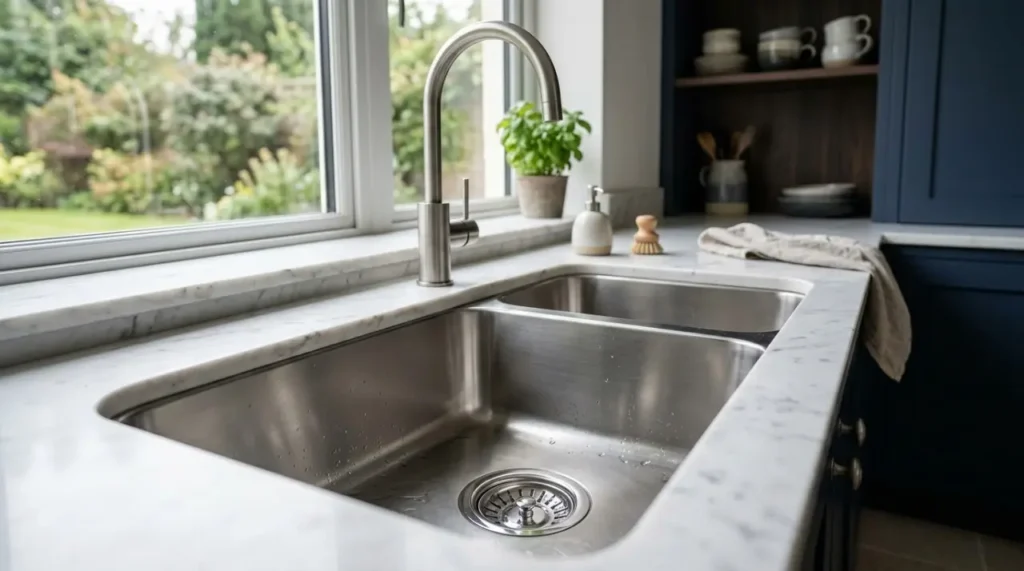
When you’re renovating your kitchen, every fitting matters, including the one most people overlook. A waste coupling for a kitchen sink is the connector that joins your sink’s drain outlet to the waste pipe running into your wall or floor. It sounds simple. It isn’t. Most buyers pick the first one they see at the hardware store. That’s usually the wrong call. There are multiple types, at least three common size standards, and material choices that directly affect how long your fitting lasts. This guide walks you through everything — types, sizes, materials, and how to pick the right waste coupling for your specific kitchen setup. What is a Waste Coupling for a Kitchen Sink? Most people think the waste coupling is just the drain plug or the strainer sitting at the top of the sink. It is not. The waste coupling is the fitting that connects your sink’s drain outlet to the waste pipe system beneath it. It does two things. First, it gives wastewater a clear exit path out of your sink. Second, it creates an airtight seal that blocks sewer gas from rising back up through your drain. The fitting has four main parts. The flange sits on top, covering the drain hole from above; this is the part you actually see. Underneath the sink, the threaded body grips the fitting securely in place. Between the two, a rubber washer does quiet but critical work: it presses against the sink base and stops water from finding a way through. The locking nut tightens from below to secure the whole assembly in place. One thing worth knowing: the waste coupling is not the same as the P-trap. The P-trap is the curved pipe you see lower down, and it serves a different function entirely. Because kitchens handle grease, food debris, and hot water daily, not every coupling is built for the job, which is why type and material matter. Types of Waste Coupling for Kitchen Sink Not all waste couplings look the same or work the same way. Before you buy, know which type actually fits your sink. 1. Full-Thread Flat Strainer Coupling Walk into any plumbing shop in India, and this is what you will see first. It fits stainless steel single-bowl sinks and has threading running the full length of its body. That full threading is what keeps it locked tight against the drain hole. It also comes with a removable strainer basket, so food debris does not go straight into your pipe. Most options in the market sit between ₹150 and ₹600. 2. Half-Thread Coupling Your sink has a small overflow slot near the top rim? Then this is your type. The threading stops halfway down the body, leaving the lower half open. That gap lets overflow water drain back in without getting blocked. It fits a specific kind of sink, so do not buy this one if your sink has no overflow channel. You will find these priced between ₹200 and ₹700. 3. Pop-Up Waste Coupling This one has a lever or knob that opens and closes the drain. No bending down, no pulling out a stopper by hand. It suits premium kitchen setups where ease of use matters. That said, kitchens with heavy daily food waste can clog the pop-up mechanism faster than you expect. Plan to spend between ₹400 and ₹1,200 for a decent unit. 4. Square Waste Coupling Granite and quartz composite sinks do not always have round drain holes. Many come with square cutouts, and the standard size you will see is 90x90mm. These couplings usually ship as part of the composite sink package, but if you are buying separately, confirm the cutout size first. Prices generally fall between ₹350 and ₹900. 5. Y-Coupling / Dual Outlet Two bowls, one drain pipe. That is the problem this type solves. It also works when your dishwasher drain needs to connect to the same sink outlet. Two inlets feed into one waste pipe, which keeps things tidy under the sink cabinet. Brass variants cost between ₹300 and ₹800. Quick Decision Shortcut: Waste Coupling Size and Material: What to Know Before You Buy Size is where most buying mistakes happen. Here is what you need to check before ordering anything. Drain hole shape: Your sink has either a round or a square drain hole. Do not assume, look at it. Round drain holes on Indian stainless steel sinks typically measure between 38mm and 45mm. Most single-bowl SS sinks from brands like Futura, Carysil, and Franke sit at 38mm to 40mm. Check the product sheet before buying. Square drain holes follow a standard 90x90mm cutout with a tolerance of plus or minus 4mm. These are almost always found on granite or quartz composite sinks. Waste pipe outlet at the wall or floor side is nearly always 40mm (1.5 inches) for kitchen sinks. Never use a 32mm bathroom basin coupling here. The pipe diameter is different, and the connection will not hold under the kitchen water volume. Measure your drain hole before ordering. A 2mm mismatch means a permanent micro-leak. Choosing the Right Material and Finish Material decides how long your fitting lasts. Here is a straight comparison: Material Best For Price Range Lifespan PVC Cold-water utility sinks ₹80–₹250 2–4 years SS 304 All Indian kitchen sinks ₹350–₹900 8–12 years Brass Premium and heavy-use setups ₹700–₹1,800 10–15 years PVD Finish Luxury and modern kitchens ₹1,200–₹3,500 10+ years PVC degrades with repeated boiling water exposure. Brass holds threads better than SS but costs more. For any Indian kitchen sink, SS 304 is the right call. On finishes, Chrome works with most taps and is the standard choice. Matte or Gunmetal suits modern flat-panel kitchens. Matte Black PVD is scratch-resistant and outlasts standard chrome plating. Rose Gold PVD sits in the luxury segment and is mostly a design choice. How to Choose the Right Waste Coupling for Your Kitchen Sink Buying the wrong coupling costs you twice — once at purchase, once when it leaks. Run
202 vs 304 Stainless Steel Sinks: Which is Better?
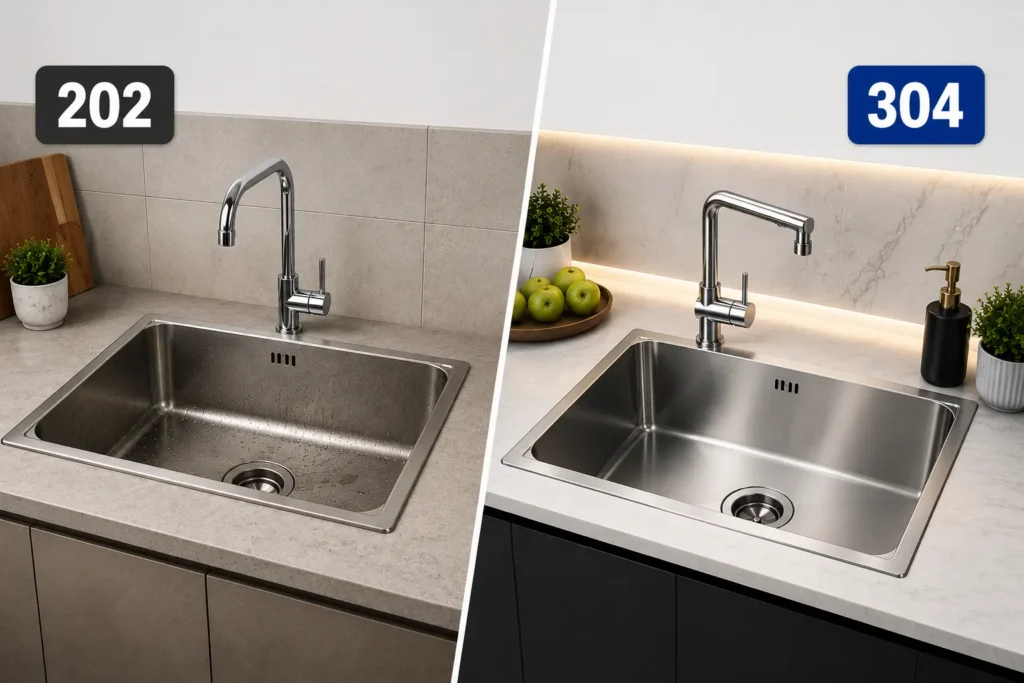
Most people pick a kitchen sink based on looks alone and regret the decision within the first few years of use. When choosing between 202 vs 304 stainless steel sinks, the grade of steel decides how long your sink lasts, how well it resists rust, and how easy it is to clean every day. The confusion between these two grades is real, especially in India. And many sellers will not explain the difference and will call both stainless steel. As a result, buyers often end up with the wrong sink for their kitchen and water conditions. This post breaks down exactly what sets these two grades apart, so you can choose with confidence. Understanding Stainless Steel Sink Grades Think of a stainless steel grade as a formula. It tells you which metals were mixed together and in what ratio. Manufacturers produce different grades because different products serve different purposes. A sink in a commercial kitchen takes far more punishment than one in a home. On the other hand, a home kitchen sink still needs to handle daily exposure to water, soap, and food acids without breaking down. Chromium and nickel are the two metals that matter most in this formula. Chromium coats the steel surface with a thin layer that keeps rust out. Nickel makes the steel tougher and keeps stains and corrosion from settling in over the years of use. More nickel in the formula means a more durable sink, and a higher price tag to match. What is a 202-Grade Stainless Steel Sink? 202-grade stainless steel is the more affordable option you will find in most budget kitchen sinks across India. Manufacturers make it by using manganese in place of a higher nickel content. The result is a more affordable steel that still offers a reasonable degree of protection against corrosion. Composition and Key Features: 202-grade steel carries roughly 16–18% chromium, around 3–4% nickel, and uses higher manganese content to compensate for the lower nickel compared to 304-grade. Chromium does provide a protective surface layer. But at lower nickel levels, the alloy cannot match 304-grade for long-term corrosion resistance. Pros: Cons: What is a 304-Grade Stainless Steel Sink? 304-grade stainless steel sits at the top end of what you will find in residential kitchen sinks. It costs more than 202-grade, and there is a clear reason for that. The metal composition is simply stronger and more capable of handling real kitchen conditions. Composition and Key Features: Grade 304 steel has 18% chromium and 8% nickel. This is why you will often see it labelled as 18/8 stainless steel — the two numbers refer directly to those percentages. This blend is food-grade, which means it is safe to be in contact with food, water, and cookware every day. Pros: Cons: 202 vs 304 Stainless Steel Sinks: Key Differences Knowing each grade separately is useful. However, seeing them side by side is what actually helps you decide. These differences directly affect how your sink performs five or ten years from now. Feature 202 Grade 304 Grade Chromium Content ~16–18% ~17–19.5% Nickel Content ~3–4% (higher manganese compensates) ~8% Rust Resistance Moderate Excellent Durability Good Excellent Lifespan 8–12 years (average use) 15–20+ years Coastal/Humid Areas Not recommended Recommended Price Range Budget-friendly Premium The single biggest factor separating these two grades is nickel content. Nickel is what gives 304-grade steel its ability to fight corrosion year after year. Because 202-grade uses manganese instead, it simply cannot match that level of protection — especially when water, soap, and food acids hit the surface every single day. As a result, the gap between these grades becomes even more significant when you factor in India’s diverse climate and water conditions. Which Stainless Steel Sink Grade is Better for Indian Kitchens? Indian kitchens are tough on sinks. Between hard water, acidic cooking, and humid climates, a sink here faces far more stress than one in a dry, temperate country. The grade you choose needs to match those real conditions — not just look good on a spec sheet. And here’s how each condition relates to the correct grade: For most Indian households, 304-grade is the practical choice, not because it costs more, but because it actually lasts. However, knowing the grade on paper is one thing. Verifying it before you buy is another matter entirely. How to Identify a Genuine 304 Stainless Steel Sink Many sinks on the market carry vague labels. Knowing what to check before paying protects you from ending up with a 202-grade sink at a 304-grade price. Knowing how to verify a grade is half the job. The other half is figuring out which grade actually fits your kitchen, your location, and your budget. When Should You Choose 202 Grade and When Should You Choose 304 Grade? Neither grade is universally wrong. The right choice depends on how you live, where you live, and how long you plan to stay. 202 Grade is a Good Fit When 304 Grade is Worth the Investment When Common Myths About Stainless Steel Sinks “304 stainless steel is 100% rust proof, correct?” It is rust-resistant, not rust-proof. Prolonged exposure to harsh chemicals or bleach-based cleaners can still damage the surface over time. “202 stainless steel is just poor quality.” That is not accurate. 202 is a legitimate steel grade that works perfectly well in the right conditions. The problem starts when buyers use it in situations it was never designed for. “A thicker gauge means a better steel grade.”These are two separate properties. Gauge measures the physical thickness of the steel sheet and affects dent resistance and noise dampening. Grade measures the alloy composition and determines corrosion resistance. A thick 202-grade sink is still more prone to rusting than a thinner 304-grade one. You need both working in your favour. “A shiny mirror finish means it is 304-grade.” The finish — matte, brushed, or mirror is a surface treatment applied after manufacturing. It has no connection to the steel grade underneath. Both 202 and 304-grade sinks
Pull-Down vs Pull-Out Kitchen Faucet: Which is Better for Your Kitchen
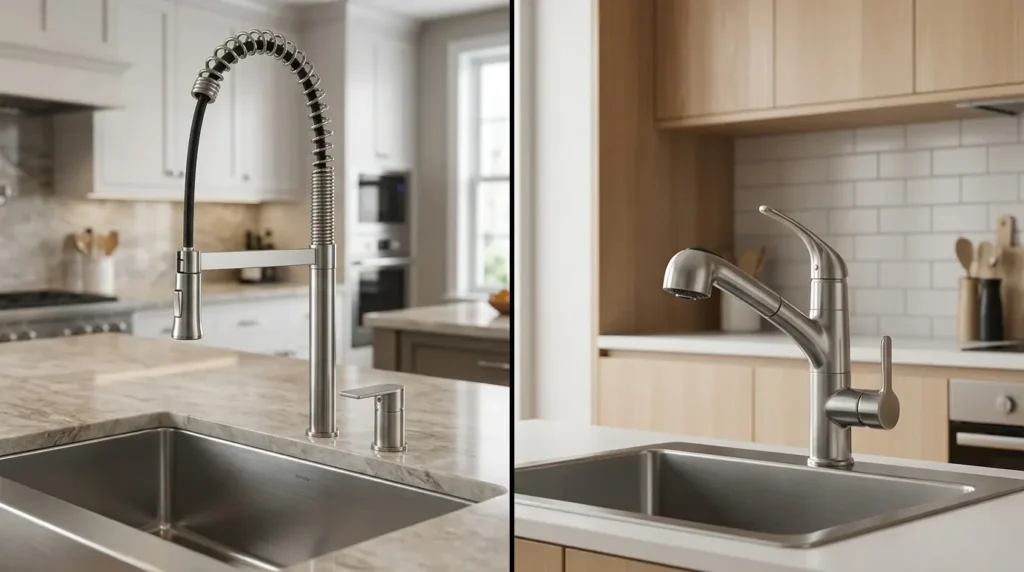
Picking a new kitchen faucet sounds simple until you start comparing options online. Two faucets can look almost the same in photos, yet work in completely different ways once they’re fixed above your sink. This is where most buyers get stuck between a pull-down and pull-out kitchen faucet. The choice matters more than it seems. A tall pull-down faucet can bump into a low cabinet. A pull-out faucet may feel too short for a deep sink full of pots. Get the wrong one, and you deal with splashing, poor reach, or an awkward fit every single day. Quick Answer: A pull-down faucet works best for deep sink and heavy cooking, like washing kadais and pressure cookers. A pull-out faucet works best for compact kitchens, shallow sinks, and low cabinets above the sink. Your sink depth, kitchen size, and cooking habits decide the right pick. Still not sure which one fits your kitchen? Let’s break it down What is the Difference Between a Pull-Down and Pull-Out Faucet? A pull-down faucet has a tall, curved spout. The spray head pulls straight down into the sink. It suits deep, single-bowl sinks and gives you room to wash large vessels. A pull-out faucet has a shorter spout. The spray head pulls out toward you instead of down. It works well in small kitchens and sinks with low cabinets above them. Feature Pull-Down Pull-Out Spout height Tall, high-arc Short, low profile Spray movement Down into the sink Out toward you Best sink type Deep, single-bowl Shallow or small Overhead space needed More Less Kitchen style Modern, bold Compact, simple Pros and Cons of Pull-Out and Pull-Down Kitchen Faucet Splashing and reach depend more on the model than the faucet type. Here’s an honest look at both. Point Pull-Down Pull-Out Washing large vessels Easier, more room Harder, less room Splash control Better in deep sinks Better in shallow sinks Reach Strong vertical reach Strong horizontal reach Fits under low cabinets No Yes Design options More finishes and spray modes Fewer, simpler options Rinsing on the counter Not ideal Very convenient Which Faucet Suits Your Indian Kitchen: Pull-Down or Pull-Out Match your kitchen setup to the right faucet using this table. Your Kitchen Better Choice Deep single-bowl sink Pull-down Small or shallow sink Pull-out Low cabinet above the sink Pull-out Frequent kadai and pressure cooker washing Pull-down Compact 1BHK or 2BHK kitchen Usually pull-out Large modular kitchen Usually pull-down Sink placed under a window Often pull-out Double-bowl sink Depends on spout reach Filling vessels on the counter Pull-out For double-bowl sinks, the real factor is how far the spout swings, not the faucet type. A pull-down with good swivel range can cover both bowls just as well as a pull-out. Which One Should You Buy: Pull-Down or Pull-Out Kitchen Faucet If you are still unsure after the tables above, let your daily routine settle it. Think about what you do at the sink most often, not what looks best in the showroom. Someone who cooks large family meals daily has different needs than someone who mostly rinses cups and plates. Final verdict: For large Indian kitchens with deep single-bowl sinks, go with a pull-down faucet. For compact kitchens, shallow sinks, or sinks under a window or low cabinet, a pull-out faucet is the safer bet. Price Range in India Prices change with brand, finish, and features. Pull-down faucets often cost a little more, mainly because of the taller build and extra spray modes, though this varies by brand and model. At the entry level, the price gap between the two types is usually small. What to Check Before You Buy Pull-Down or Put-Out Kitchen Faucet Common Mistakes to Avoid When Buying Choosing based only on looks. A tall, striking faucet may not fit under your cabinet once it’s installed. Can You Replace a Pull-Out Faucet With a Pull-Down Faucet? Yes, in most cases. You do not need to replumb your kitchen. The real thing to check is physical fit, not plumbing. Before you swap, check: If the fit works, a plumber can usually handle the swap in a single visit. Final Thoughts There is no single winner in the pull-down vs pull-out kitchen faucet debate. A pull-down kitchen faucet suits deep sinks, large cookware, and bigger modular kitchens. A pull-out kitchen faucet suits shallow sinks, low cabinets, and compact 1BHK or 2BHK homes. Before you buy, measure your sink depth, check the space above your sink, and think about how often you wash large vessels. Match these to the tables above, and the right kitchen faucet becomes an easy pick, not a guessing game. Frequently Asked Questions Which is Better, Pull-Down or Pull-Out Kitchen Faucet? It depends on your sink and kitchen size. Pull-down suits deep sinks and heavy cooking. Pull-out suits small kitchens and shallow sinks. Do Pull-Down Faucets Splash More Than Pull-Out Faucets? Not always. Splashing depends on sink depth, water pressure, and spray mode, not just the faucet type. Which Kitchen Faucet is Easier to Clean: Pull-Down or Pull-Out? Both are easy to clean. Wipe the spray head with a soft cloth weekly to stop mineral buildup, especially in hard water areas. Which Kitchen Faucet Lasts Longer? Faucet life depends on build quality, not the type. Brass bodies and ceramic cartridges outlast cheaper materials in both styles. Does the Faucet Type Work with an RO or Water Purifier Connection? Faucet type is not the deciding factor here. Most RO and water purifier systems use their own separate tap, not the main kitchen faucet. What matters is whether your countertop and sink have enough holes for the main faucet, the RO tap, and a soap dispenser, if you want all three. Does the Faucet Type Affect My Water Bill? Not directly. Water use depends on the flow rate and spray mode, not whether it is pull-down or pull-out. Check the flow rate in the product details. Which Faucet is Better for a Family that Cooks a Lot? A pull-down faucet usually works better. It
Different Types of Waste Couplings for Indian Homes
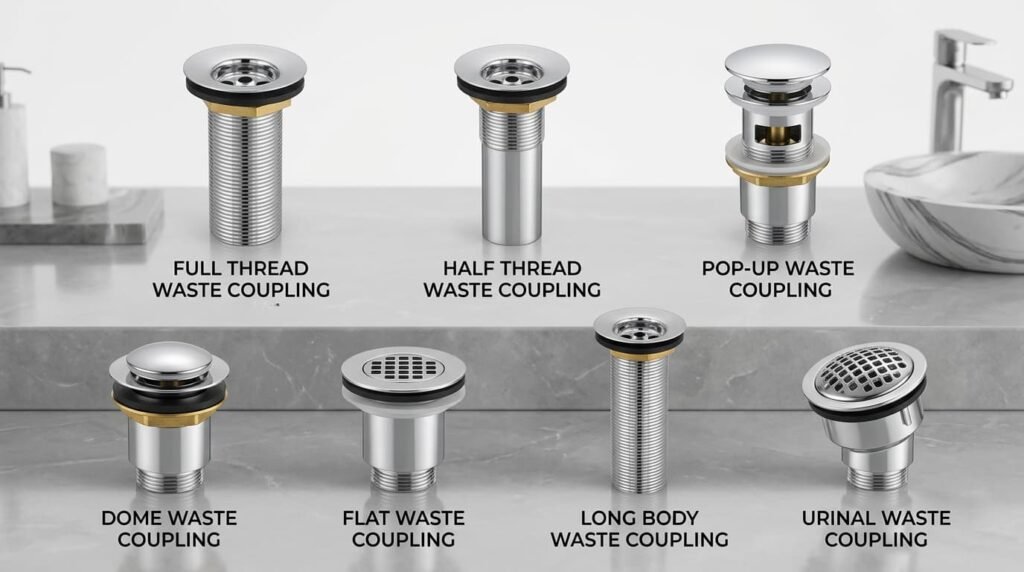
A waste coupling is the small fitting that joins your sink, basin, or urinal to the drain pipe below. It looks tiny, but it decides whether your drain leaks, smells, or works quietly for years. Pick the wrong one, and you will deal with wobbly fittings, bad odour, or water pooling under the sink. Pick the right one, and you will forget it is even there. This guide walks through every common waste coupling type sold in India, what each one is best for, and how to choose without guesswork. What Does a Waste Coupling Do? A waste coupling sits directly under the drain hole of a basin, sink, or urinal and carries used water into the waste pipe without letting it escape at the joint. Depending on the design, it may also catch hair, food scraps, and soap residue before they reach the pipe — or seal against sewer gas rising back up into the room. You’ll find one under nearly every fixture that drains: wash basins, kitchen sinks, urinals, bathtubs, and floor drains. Anywhere water needs to leave a fixture and enter a pipe, a waste coupling is doing the work quietly in between. The Main Types of Waste Couplings Manufacturers build different couplings for different jobs — thread pattern, drain mechanism, and shape all change depending on where the fitting is going. Full Thread Waste Coupling Threading runs the entire length of the body, top to bottom, which locks the fitting firmly into the drain outlet once fully screwed in. Thick countertops and vessel basins that see constant daily traffic benefit most from this design, since the full-length grip resists loosening over time. Half Thread Waste Coupling Only the lower portion is threaded; the rest slides in without turning. Installation takes fewer turns and less time, which is probably why it’s the type installers reach for most often on standard table-top and wall-hung basins across Indian homes. Pop-Up Waste Coupling A push-button stopper replaces the manual plug — press once to fill the basin, press again to drain it. Mid-range and premium basins favour this mechanism because it keeps the sink looking clean, with nothing sitting loose on the counter. Dome Waste Coupling A raised dome covers the drain hole, letting water pass through the gaps while blocking larger debris. Kitchens and bathrooms both use this often, since it’s cheap, easy to clean, and does a reasonable job keeping food scraps and soap chunks out of the pipe. Flat Waste Coupling No raised dome here — the strainer sits level with the sink surface, which suits shallow drain outlets that can’t accommodate a raised fitting. Modern, minimal basin designs tend to specify this for a smoother, low-profile look. Long Body Waste Coupling For basins positioned further from the waste pipe than usual, this coupling’s extra length closes the gap directly, without stacking on additional pipe joints. It saves both material and installation time on non-standard layouts. Urinal Waste Coupling Built specifically for urinals, connecting to the trap below and handling frequent, steady water flow. It isn’t interchangeable with basin or sink couplings — the size and flow design are different. Every type has its place. But full thread and half thread tend to confuse people the most at the time of buying. Let us sort that out right now. Half Thread vs Full Thread: Quick Comparison Feature Half Thread Full Thread Thread coverage Lower half only Entire body Best for Standard, thin countertops Thick countertops, vessel basins Installation Quick, fewer turns Takes longer to thread in Grip strength Good for regular use Stronger, more secure Rule of thumb: thin countertop or wall-hung basin → half thread. Thick counter or deep vessel basin → full thread. Materials to Know Before You Buy Waste Coupling Price Range in India Type Approximate Price (INR) PVC Coupling ₹80 – ₹250 Stainless Steel Coupling ₹200 – ₹600 Brass Coupling ₹350 – ₹1,200 Chrome-plated brass/pop-up/click-clack ₹500 – ₹2,000+ Treat these as indicative ranges. Actual prices shift with brand, finish, and whether the coupling includes an overflow connector. Always check current listings before buying, since prices move. How to Pick the Right Waste Coupling Bottom Line Once you know your basin type, outlet size, and how much daily use it’s in for, picking a waste coupling stops being a guessing game. Measure the outlet first, match the thread type to your countertop, and choose a material suited to your water conditions. Get those three things right, and you genuinely won’t think about this fitting again for years. Not sure which size or type fits your basin? Browse our waste coupling collection at Begin Faucets — filter by size, material, and finish, or send us your basin’s outlet measurement and we’ll point you to the right match before you order. Frequently Asked Questions What’s the Difference Between a Waste Coupling and a P-Trap? A waste coupling connects the basin to the pipe. A P-trap is the curved section of pipe that holds water to block sewer gas. Bottle trap couplings combine both functions in a single fitting. Can I Install a Waste Coupling Myself? For most basin types, yes — a wrench and plumber’s tape are usually enough. Concealed or floor couplings are better left to a plumber, since they involve wall or floor work. Does a Waste Coupling Need Plumber’s Tape? Yes, on threaded types. Wrapping tape around the threads before fitting helps prevent leaks at the joint. Why Does My New Waste Coupling Still Leak? Usually one of three things: the locking nut isn’t fully tight, the washer is sitting crooked, or the coupling size doesn’t match the drain outlet. Is a Costlier Waste Coupling Always Better? Not necessarily. Brass lasts longer, but a good stainless steel coupling handles normal home use perfectly well at a lower price point. How Long Does a Waste Coupling Last? Roughly 5 to 10 years under normal use, depending on material and local water quality. Is There an Indian Standard for Waste Couplings? Copper-alloy (brass) waste
Double Bowl Sink Benefits: Price, Sizes & Buying Guide for Indian Kitchens (2026)
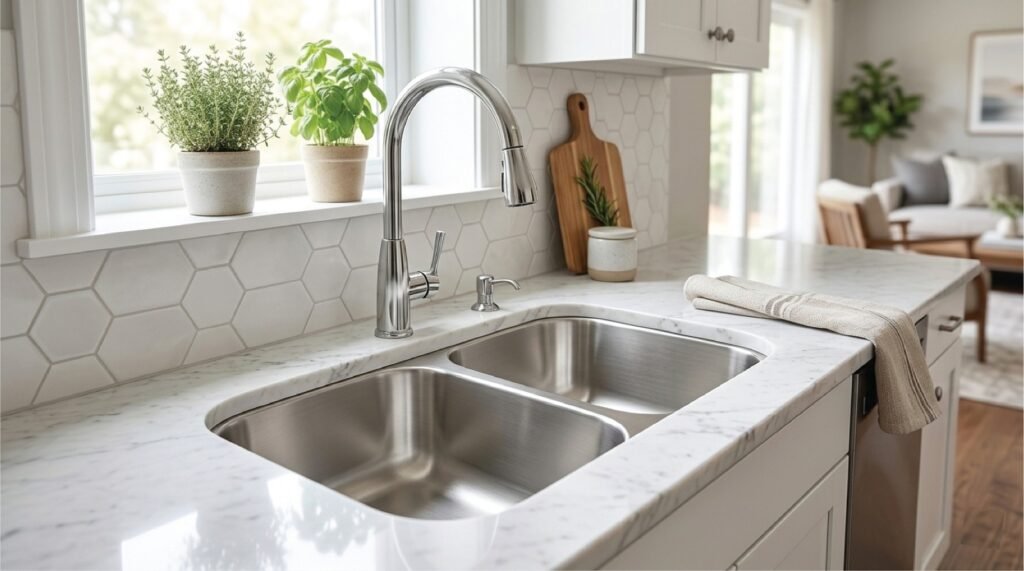
A double bowl sink is fast becoming the go-to choice for Indian kitchens, and it’s not just a style trend. It solves real problems: washing and soaking at the same time, keeping raw food away from dirty dishes, and letting two people cook without bumping into each other. This guide covers the real double bowl sink benefits, how to pick the right material for your water conditions, how to size a sink to your actual counter, and what you should reasonably expect to pay in 2026. What is a Double Bowl Sink? A double bowl sink has two separate basins side by side, typically each connected through a double-bowl waste kit to a common drain line. You can use both sides at once, or keep one dry while the other does the heavy lifting. It’s built for kitchens where more than one thing happens at a time, which, in most Indian homes, is every single day. There are Two Main Types: 7 Real Benefits of a Double Bowl Sink for Indian Homes The Trade-Offs A double bowl sink isn’t right for every kitchen. It takes up more counter space than a single bowl, and it eats into your under-sink storage because of the extra plumbing. Each bowl is also a bit smaller than one big basin, so oversized tawas or baking trays can be awkward to fit. If your kitchen is compact or you live alone, a single bowl sink with more open space might actually serve you better. Equal Bowl vs. Offset Double Bowl: Which is Better? Select an equal bowl if: Select an offset bowl if: Which Material Should You Pick? Your water conditions and budget should guide this decision, not looks alone. Hard water isn’t the only factor in corrosion — water chemistry, chlorides, cleaning chemicals, and the quality of the steel itself all play a role. As a rule, a SS 304 sink of good quality will be more corrosion resistant than a similar quality SS 202 sink, particularly in hard water or humid conditions. Material Best For Watch Out For Price Range Steel Grade 304 Hard water cities like Delhi, Jaipur, Ahmedabad Costs more than 202 ₹5,000 – ₹20,000 Steel Grade 202 Tight budgets, rental homes Rusts faster over time ₹1,500 – ₹8,000 Granite composite Quiet, scratch-resistant kitchens Light colours show turmeric stains ₹8,000 – ₹30,000 Quartz composite Long-term, low-maintenance use Higher upfront cost ₹15,000 – ₹50,000 Fireclay Farmhouse-style kitchens Heavy, can chip ₹20,000 – ₹60,000+ Note: Prices vary by brand, dimensions, thickness, finish, and accessories included — treat these as approximate retail ranges, not fixed prices. SS 202 is generally more budget-friendly but offers lower corrosion resistance than SS 304 in demanding environments. In hard water or heavy daily use, it may show staining or wear before SS 304 — but exactly when depends on thickness, manufacturing quality, and maintenance, not a timeline. What Size Fits Your Kitchen? Home size (1BHK, 2BHK, etc.) is a rough starting point, but it doesn’t actually determine sink size — a 2BHK can have anything from a tiny galley kitchen to a large modular one. The better starting point is your available counter width and cabinet size. Available Kitchen Space Useful Starting Point Compact counter 24–30 inch sink Standard modular kitchen 30–36 inch sink Spacious kitchen 36–42 inch sink Large kitchen / heavy daily use 42–45 inch sink Most Indian modular counters are around 600mm deep, which is a useful general reference, but counter depth and sink cutout dimensions aren’t the same thing. Always check the manufacturer’s cutout template against your actual cabinet width and depth before ordering, and confirm the cabinet has enough internal space for the bowls and waste plumbing. Also leave 4–5 inches of space behind the sink for the tap. Bowl depth matters too. A shallow bowl causes more splashing and makes washing large utensils harder; a very deep bowl can be uncomfortable to reach into, especially for shorter users. Compare overall depth, bowl depth, and your counter height rather than picking on size alone. Double Bowl Sink Price in India Prices vary by brand, dimensions, steel grade, thickness, finish, mounting style, and included accessories. The ranges below are approximate retail bands rather than fixed prices. Budget What You Get Best For ₹2,000 – ₹5,000 Thin steel, basic finish, no sound padding Rentals, very tight budgets ₹5,000 – ₹10,000 Grade 304 steel, decent thickness 1BHK and small 2BHK homes ₹10,000 – ₹15,000 Thicker gauge, anti-scratch coating Families with heavy daily use ₹15,000 – ₹30,000 Granite composite, sound-dampened Modern modular kitchens ₹30,000+ Quartz or fireclay, long warranty Premium kitchens Keep an extra ₹1,000–₹2,500 aside. Sink prices rarely include installation, drain pipes, or tap fitting — those come separately, and actual installation cost depends on your existing plumbing, whether a double waste kit is included, and local plumber charges. Best Double Bowl Sink Types for Different Indian Kitchens Should You Pick Double Bowl or Single Bowl? Go double bowl if you cook daily in large amounts, hand-wash everything, or often have two people working in the kitchen at once. Go single bowl if your kitchen is small, you live alone or as a couple, or you mostly wash large flat items like tawas that need one big open space. Neither choice is wrong; it depends on how busy your kitchen actually gets. Quick Checklist Before You Buy a Double Bowl Sink Final Thoughts The right double bowl sink comes down to a few things: your water quality, your available counter space, and how your family actually cooks. Check the steel grade, measure your cabinet and cutout properly, and pick a size that matches your actual counter rather than your home type. Do that, and you’ll have a sink that handles your daily cooking chaos for years without a single complaint. Frequently Asked Questions Does a Double Bowl Sink Cost More to Install Than a Single Bowl? It can, since it typically needs a double-bowl waste kit and extra fitting work. The exact cost depends on