

Table Top vs Wall Mounted Wash Basin: Which is Better 2026
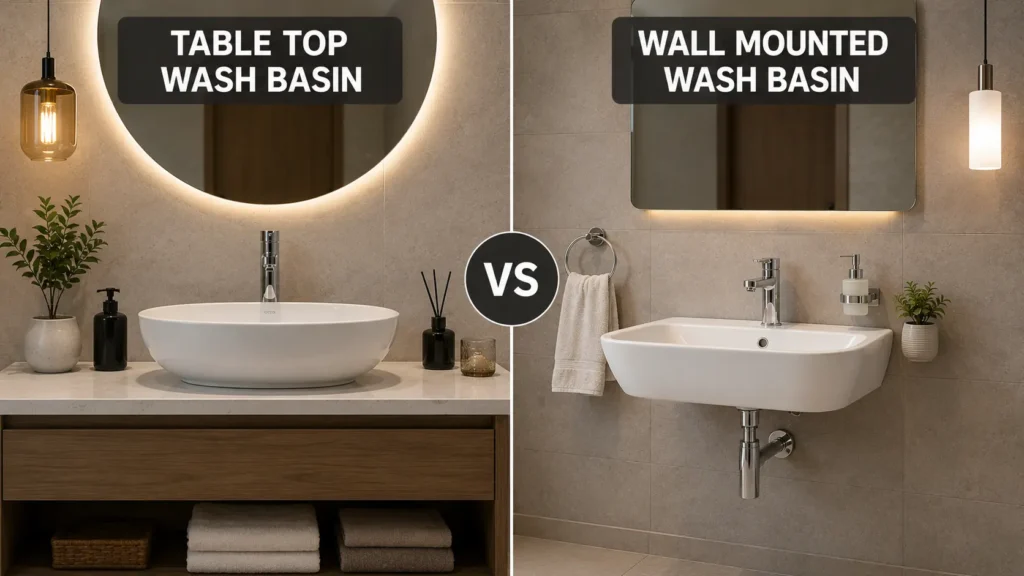
In India today, two styles dominate the shelves: the tabletop wash basin and the wall-mounted wash basin. So which one wins for your bathroom? That depends on a few things we’re about to unpack, including real space needs, plumbing, faucet type, and price. If your bathroom is small, go with a wall-mounted basin; it keeps the floor open and free. If you want a vanity with storage and a look that feels a bit more premium, a table top basin usually delivers that better. Most compact Indian bathrooms lean toward wall-mounted, while larger or master bathrooms often suit table-top basins. Table Top vs Wall Mounted Wash Basin: Quick Comparison Feature Table Top Wash Basin Wall Mounted Wash Basin Installation Sits on a counter or vanity Fixed directly to the wall Countertop needed Yes No Storage Vanity underneath can hold items Very limited Floor space Takes up more space Keeps the floor open Cleaning Wipe the counter and base Mop the open floor easily Design style Bold, decorative Simple, minimal Best for Large or master bathrooms Small or compact bathrooms Starting price in India Around ₹1,200 Around ₹1,000 What is a Table Top Wash Basin? Think of a bowl sitting on a table, and you’ve basically pictured a table top wash basin. It rests on top of a counter or vanity rather than being built into it, which is why some people call it a vessel sink or a countertop basin. Pros of Countertop Wash Basin Cons of Countertop Wash Basin What is a Wall Mounted Wash Basin? A wall mounted wash basin, sometimes called a wall hung basin, skips the counter altogether and bolts straight into the wall. No vanity required underneath. Pros of Wall Mounted Wash Basin Cons of Wall Mounted Wash Basin Faucet Compatibility While Choosing Wash Basin Here’s a mistake a lot of buyers make. They pick the basin first, love the look, and only think about the tap once the basin is already home. That order can backfire. A table top basin usually calls for a tall basin mixer or a wall mounted tap. Since the basin sits higher up on the counter, a short tap might not even reach the water properly into the bowl. A wall-mounted basin is more flexible here. It can work with a deck-mounted basin mixer, a wall-mounted faucet, or a single-hole tap, depending on what tap holes the basin comes with. Because the basin height gets fixed during installation, it’s actually simpler to plan where the tap should sit. Before you commit to either basin, check the tap holes, the spout reach, and your home’s water pressure. That small check now can save you an expensive fix later. Which One Should You Choose: Wall Mounted or Table Top Wash Basin Truth is, there’s no universal winner. It comes down to your bathroom’s size, your budget, and how you actually use the space day to day. Table Top Might Be Right If: Wall Mounted Might Be Right If: A Quick Reference Table Your Situation Better Choice Small bathroom Wall mounted Need vanity storage Table top Want maximum floor visibility Wall mounted Premium or designer bathroom Table top Rented home or PG Wall mounted Family bathroom with shared use Depends on storage needs Priority on easy floor cleaning Wall mounted Want a statement piece Table top Two things are easy to overlook here. First, a table top basin doesn’t automatically mean a taller setup. The finished rim height is the counter height plus the basin height added together, so a deeper vessel basin often needs a lower counter to stay comfortable. Second, a wall-mounted basin saves floor space but not wall space. It still projects outward from the wall, so in a narrow bathroom, that measurement matters if you don’t want it blocking the door or shower entry. Price Comparison in India Money is usually what tips the decision for most Indian households. The figures below reflect indicative online prices checked in 2026. Treat them as a starting point rather than a fixed number, since brand, finish, size, retailer, and ongoing discounts all move the price around. The basin price alone doesn’t tell the full story, though. The real installed cost includes the basin, faucet, waste coupling, trap, and labour. Add a countertop or vanity if you’re going table top. A wall-mounted basin skips that expense but might need extra wall reinforcement instead. It’s worth asking your dealer or plumber for a full quote before deciding, rather than comparing basin prices alone. Popular Brand Options in India for Wall Mounted and Table Top Wash Basins Basin Type Brand and Model Approx. Price Table Top Hindware Evita (Cat. 10101) ₹1,850 – ₹3,425 (varies by retailer/finish) Table Top Hindware Etios ₹2,999 – ₹4,165 Table Top Hindware Cora (Cat. 91203) ₹8,400 – ₹8,920 — confirmed close to original figure Table Top / Counter CERA Clair / Camry / Concord ₹2,000 – ₹15,000 (CERA’s own stated range for its counter basin line) Wall Mounted Parryware Wall Hung Basin (e.g. Cascade Classic, Vista) ₹2,000 – ₹8,500 (varies widely by model/size; no single official range published) Wall Mounted CERA Wall Hung Range ₹1,500 – ₹8,000 (broad range across models; CERA doesn’t publish one fixed band) Wall Mounted / Semi-Recessed Jaquar JDR Semi-Recessed Basin (JDS-WHT-25501) ₹5,400 – ₹9,600 (retailer prices vary significantly — several list it above ₹9,000) Quick note on that last one: the Jaquar JDR 25501 is a semi-recessed model, a hybrid that sits partly in a counter cut-out. It isn’t a direct table top or wall mounted match, but it’s worth knowing about if you want a middle ground. These brands have solid dealer networks across Indian cities, which counts for something when you need service or spare parts years down the line. As always, confirm current pricing before you buy, since these numbers shift. Things to Check Before You Buy a Wash Basin Run through this list before you finalize anything: Small checks like these prevent big headaches during installation. Final Thoughts At the
How to Install a Tabletop Wash Basin: Steps & Tips 2026
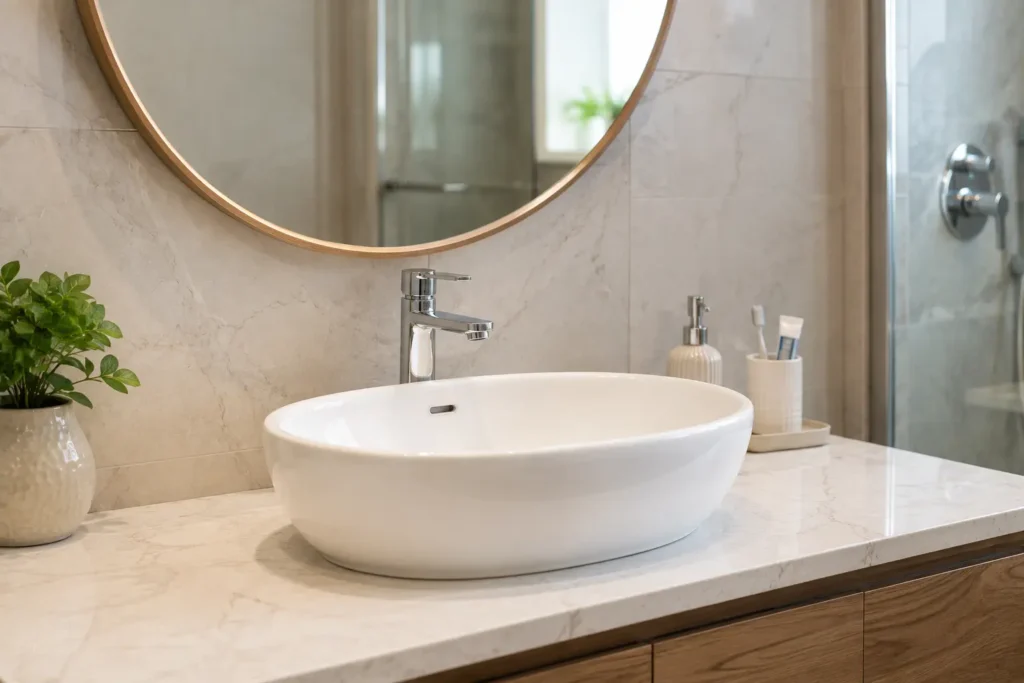
A tabletop wash basin looks simple to fit. But most leaks, wobbly basins, and splash problems in Indian bathrooms trace back to a few avoidable mistakes. Get the height right, pick the correct waste coupling and trap, and seal it properly, and the basin will serve you for years. To install a table top wash basin, work out your counter height based on the basin’s own height, mark the drain position, cut the counter as per the manufacturer’s template, fit the tap, fit the waste coupling, apply sealant, place and level the basin, connect the trap and water lines, test for leaks, and let the sealant cure for about 24 hours before use. This guide covers what to check before you start, the tools you need, the full process, how to pick the right waste and trap, common mistakes, and cost in India. What is a Table Top Wash Basin A table top wash basin sits on top of a counter or vanity instead of being built into the wall or under the counter. It looks like a bowl placed on a table, which is where the name comes from. You will also see it called a countertop basin or a vessel basin. This style is popular in Indian homes because it gives a clean, hotel-like look and frees up storage space below the counter. It is also easier to replace later than a wall-hung basin if you want to change your bathroom design. Planning the Right Height for Your Wash Basin Before Installation Since the basin sits above the counter, the finished rim ends up taller than the counter itself. Build the counter at the same height as a normal vanity, and the basin may sit too high for comfort. Use this Simple Method: Counter height equals your target rim height minus the basin’s own height. For example, if you want a certain rim height and know how much the basin adds on top of the counter, subtract that basin height to get your counter height. The exact basin height varies by model, so always check the product’s spec sheet before fixing your counter height. This one check prevents most comfort complaints later. Things to Check Before You Start Installing Counter Wash Basin Tools and Materials You Need A Note on Sealant: Neutral-cure silicone is the safer choice for bathrooms, since it will not corrode metal fittings or discolour natural stone the way some acid-cure sealants can. Acid-cure types bond well to plain ceramic and glass but are best avoided near stone counters and metal fixtures. Steps to Install a Tabletop Wash Basin Step 1: Turn off the water supply at the isolation valves before touching any pipework. Step 2: Mark the position. Decide where the basin sits and mark the centre line, leaving enough space on both sides for comfortable use. Step 3: Cut the hole, if needed, using the manufacturer’s template. Go slow, especially on stone. Step 4: Dry-fit the basin to check alignment with the waste outlet. Step 5: Fit the tap first. It is easier to tighten from below before the basin is in place. Step 6: Fit the waste coupling. Place the gasket and tighten it into the drain hole. Most Indian basins use a 32mm waste coupling, but check your basin’s spec sheet to confirm. Step 7: Apply sealant. Run a smooth, even bead of neutral-cure silicone where the basin meets the counter. A thin, even line seals as well as a thick one and looks neater. Step 8: Place and level the basin, checking with the spirit level. Step 9: Connect the trap, keeping it straight and aligned with the wall drain, not angled. Step 10: Connect the water supply with flexible hoses, then turn the water on slowly and check every joint for drips. Step 11: Let the sealant cure, usually around 24 hours, though this varies by product. Avoid heavy use until then. Choosing the Right Waste Coupling, Trap, and Tap Waste Coupling Check for a small overflow hole near the basin’s top rim. If it has one, use a slotted waste coupling, which lets overflow water drain safely. If there is no overflow hole, use an unslotted waste coupling. Fitting the wrong type can cause leaks or make the overflow useless. Trap Type A bottle trap is common with table top basins in India, since it looks neat where plumbing is visible and takes less space. If your drain line is concealed inside a vanity or wall, a P-trap works just as well and can be easier to clean. What matters most is that the trap sits straight, holds water to block drain smells, and stays accessible for cleaning. Tap Choice A tall body basin mixer or wall-mounted spout usually suits a table top basin better than a short tap, since a short tap may not reach the bowl’s centre and can cause splashing. A tap set too high above a shallow basin causes the same problem. Check the spout’s height and reach against your basin’s depth before buying. Common Mistakes to Avoid DIY or Call a Plumber If your plumbing points are ready and the cut-out is done, installing the basin yourself is manageable with basic tools and patience. Many homeowners in India do this successfully. Hire a professional if you are cutting a stone counter, setting up new plumbing lines, or fitting the vanity and basin together for the first time. A mistake with stone cutting can be costly to fix. Troubleshooting and Maintenance Tips If something is not working right after installation, use this table to find the likely cause. Problem Likely Cause Basin feels wobbly Sealant has not cured, or the basin was not levelled before it set. Water splashes outside the bowl Tap’s spout height or reach does not match the basin’s depth. Slow drainage Trap is blocked, or the waste coupling is the wrong size. Bad smell from the drain Trap is not holding water properly. Leak under the basin Sealant line
Wash Basin Size Guide for Indian Homes 2026
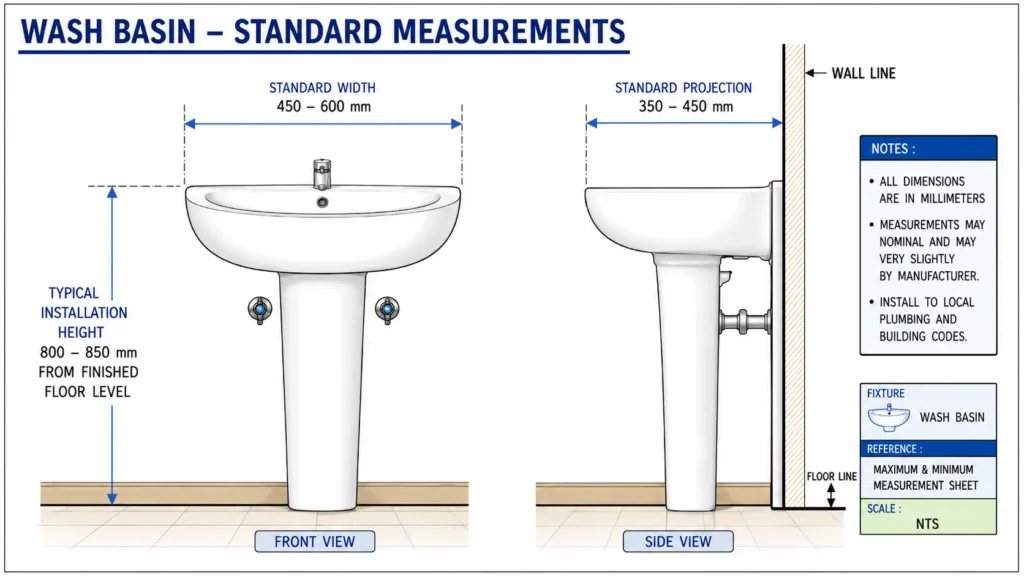
Choosing the right wash basin size is not just about looks. The wrong size can crowd your bathroom, splash water, or leave you stooping every morning. This wash basin size guide India covers common dimensions, basin types, and buying advice, so you can measure once and buy right. Most standard wash basins sold in India are around 450–600 mm (18–24 inches) wide, with a projection of roughly 350–450 mm (14–18 inches) from the wall. Installation height typically falls between 800 and 850 mm (32–34 inches) from the finished floor, though the ideal height depends on the basin type and the people using it. This guide gives sizes in millimetres, centimetres, and inches, because Indian plumbers and tilers work in mm while most buyers still think in inches. Standard Wash Basin Size in India (mm, cm & inches) Before you shop, know the four numbers that matter most: width, projection, bowl depth, and height. These are typical market ranges based on commonly sold basins, not fixed rules. Measurement mm cm inches Width 450–600 45–60 18–24 Projection (wall to front edge) 350–450 35–45 14–18 Bowl depth (top to lowest point) 120–200 12–20 4.7–8 Installation height from floor 800–850 80–85 32–34 A basin within this range fits most Indian bathrooms without needing custom plumbing work. Brand size reference: Parryware’s wall-hung range alone spans 450×330×210 mm, 500×400×210 mm, and 570×440×200 mm models, all within the ranges above. When shortlisting, check the size chart on the brand’s own product page (Cera, Hindware, Parryware, Jaquar, and Kohler all publish these) rather than relying on the showroom display model. What Do Wash Basin Dimensions Mean? Product listings often use these terms loosely: Knowing these terms prevents the most common ordering mistake: the right width paired with the wrong projection. Wash Basin Size Chart by Type Different basin types come in different size ranges. Use this table to match a type to your bathroom layout before you check the price tag. Basin Type Typical Width (mm) Best For Notes Corner basin 350–450 Very small or awkward-shaped bathrooms Fits into unused corners; limited storage below Wall-hung 450–600 Small to medium bathrooms, modern homes Easy to clean underneath; needs strong wall support Pedestal 450–550 Traditional Indian bathrooms Hides plumbing pipes; limited counter space Countertop / tabletop 400–550 Bathrooms with a vanity counter Sits above the counter, so total height increases Under-counter 400–500 Modern vanities with storage Rim sits flush with counter for easy wiping Semi-recessed 450–550 Narrow bathrooms Half the basin sits inside the counter to save projection Large / double vanity 900–1200 (combined) Shared or master bathrooms Two basins for couples or family use; combined width, not per-basin Recommended Wash Basin Size by Bathroom Size (Planning Guide) These ranges are practical planning recommendations, not fixed standards. Your final basin size still depends on door swing, WC position, shower enclosure, and where the drain outlet already sits. Bathroom Size Recommended Basin Width Best Type Powder room (below 4×4 ft) 400–450 mm Corner or compact wall-hung Small bathroom (4×6 ft) 450–500 mm Wall-hung or semi-recessed Standard bathroom (5×7 ft) 500–550 mm Wall-hung or pedestal Large bathroom (6×8 ft) 550–600 mm Countertop or under-counter Master bathroom (8×10 ft or above) 600 mm and above, or double vanity Large countertop or double basin For comfortable planning, aim for 100–150 mm of clearance between the basin and the nearest wall or fixture, where your layout allows it. Always cross-check this against the basin’s installation template before finalising the plumbing points. Wash Basin Size vs Vanity Size A basin only works well when the vanity below it is wide enough. A tight vanity leads to splashed water, cluttered counters, and a basin that looks out of place. Basin Width Minimum Vanity Width Needed 450 mm 600 mm 500 mm 650 mm 550 mm 700 mm 600 mm 750 mm The vanity is typically around 150 mm wider than the basin overall, which works out to roughly 75 mm of extra space on each side when the basin sits centered. Treat this as a practical starting point rather than a fixed rule; the exact figure depends on the basin’s mounting method and the manufacturer’s own template. Standard Wash Basin Height & Installation Clearances BIS quality norms for ceramic sanitaryware (IS 2556) cover glaze, strength, and finish, not a single fixed installation-height clause. The 800–850 mm figure is accepted industry practice among Indian architects and plumbers, and it suits most adult users. To know more about wash basin height, check out this blog: [Wash Basin Height Guide]. What to Measure Before You Buy a Wash Basin This step saves the most returns and site delays. Before you order, note down: wall width, available projection, intended rim height, drain and water inlet locations, faucet hole configuration, counter cut-out size (for counter basins), door swing clearance, and distance from the WC. Share these with the seller before you finalise a model. How to Choose the Right Wash Basin Size A simple flow: measure wall width and projection first, shortlist a type that fits, then match it to your drain and faucet configuration. Limited projection usually points toward a compact wall-hung or semi-recessed basin over a full pedestal. Common Wash Basin Size Mistakes to Avoid Even careful buyers slip up on a few common points: Final Thoughts The right wash basin size depends on your bathroom footprint, vanity width, and how the space is actually plumbed, not on looks alone. Use the tables above to shortlist a range, measure against the checklist, then verify exact dimensions on the manufacturer’s product page before you buy. A little measuring now saves you a return or a redo later. Frequently Asked Questions What is the Standard Wash Basin Size in India? Most basins sold in India fall between 450 and 600 mm wide, with a projection of 350 to 450 mm and a bowl depth of 120 to 200 mm. These are common market ranges rather than a single fixed number. Which Wash Basin Size is Best for a Small Bathroom? For