
Is your health faucet giving a weak spray? Learning how to clean a health faucet head can fix that fast. A dirty nozzle is very common — especially in Indian homes where hard water leaves white mineral crust that slowly chokes the spray holes.
The good news is you do not need a plumber or any special tools.
In this blog, you will learn the right way to clean your health faucet head at home, when to replace it, and how to keep it clean for longer. Most people finish in under 30 minutes. Let’s get started.
Why Does a Health Faucet Head Get Dirty or Clogged?
Your health faucet head deals with a lot every single day. It collects dirt and clogs over the years. Here are the main culprits:
- Hard water mineral deposits (calcium and magnesium)
- Soap scum and residual residue
- Dust and lint from the environment
- Mould and bacteria due to constant moisture
The biggest culprit in the majority of Indian homes is hard water deposits on the surface of taps. Cities like Delhi, Lucknow, and Ahmedabad have water that carries heavy minerals.
Once this water dries up on the nozzle, it leaves a white or yellowish crust behind, and that crust slowly chokes the small spray holes. Soap scum blocks holes from the outside, while mineral deposits clog them from inside.
This is exactly why your faucet starts throwing water in odd directions or loses pressure.
Signs Your Health Faucet Head Needs Cleaning
Check your faucet regularly. These signs tell you it’s time for a clean:
- The health faucet has low water pressure that feels weaker than usual.
- Water is spraying sideways or shooting out unevenly.
- White or yellow crust around the nozzle holes.
- Black spots or dark discoloration on the head- act on this quickly, it usually means mould.
- A bad or musty smell coming from the spray — this also needs urgent attention.
If you see any of these signs, clean your faucet head right away. Black spots and a bad smell mean mould — do not delay on those.
Things You’ll Need Before You Start
Before you even start, grab these easy-to-find items:
- White vinegar (100–200 ml is enough for one soak)
- Warm water
- Soft toothbrush
- Microfiber cloth
- Small bowl or zip-lock bag (a bowl with a rubber band also works if you don’t have a zip-lock bag)
- Rubber gloves
- Toothpick (optional — for stubborn holes)
You probably have most of these already at home.
The Basic Cleaning Method for How to Clean Health Faucet Head
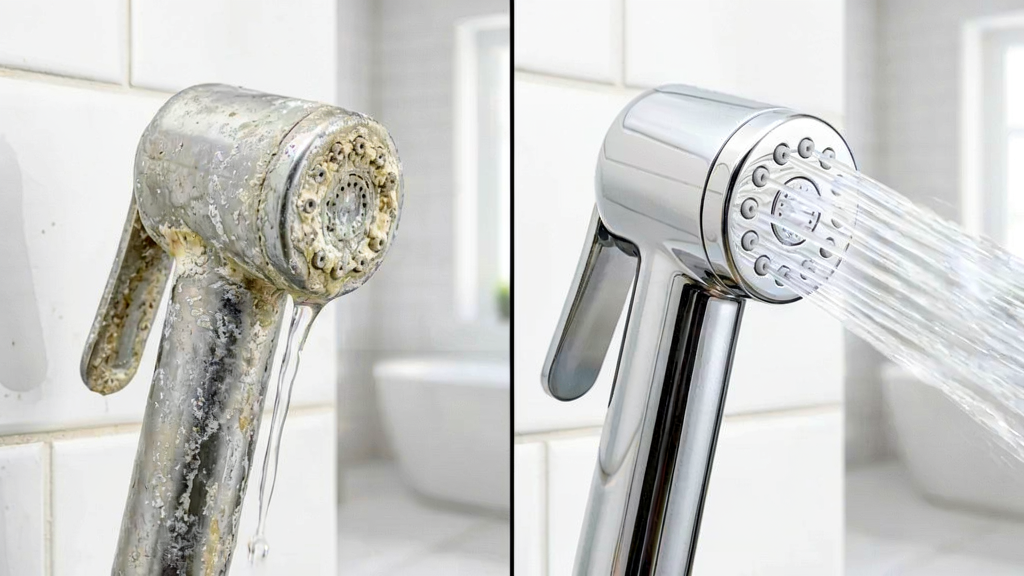
Whether your spray head is removable or not, the core cleaning method is the same — a vinegar soak followed by a gentle scrub. Here is how to do it.
Step 1: Prepare your vinegar solution
Mix equal parts white vinegar and warm water. This simple solution works surprisingly well on the white crusty deposits that block your faucet nozzle.
For heavy white crust, soak for the full 2 hours. If vinegar alone does not work after two attempts, use a store-bought descaler such as diluted citric acid powder, which is easily available online.
White vinegar contains 5 to 8% acetic acid, which dissolves calcium carbonate — the main mineral in limescale. Never use bleach or strong acid on chrome fittings, these strip the finish and cause permanent damage.
Step 2: Soak the spray head
Submerge the spray head fully in the vinegar solution. For light buildup, 30 to 60 minutes is enough. Not sure if your buildup is light or heavy? Try scraping it with a fingernail — if it comes off easily, it is light. If it is rock-hard, soak for 2 hours.
Step 3: Scrub gently
Slip on your rubber gloves. Take your soft toothbrush and work it gently across the nozzle. To properly clean the health faucet nozzle holes, use a toothpick to poke through any holes that still look blocked.
Never use a metal pin or needle — it bends and tears the tiny holes, ruining the spray pattern completely.
Step 4: Rinse and test
Turn the faucet on and let the water run hard for 30 seconds. This flushes out everything the vinegar loosened inside. Dry the head with your microfiber cloth once done.
Quick Tip: Stand back and watch the spray after rinsing. Even flow and stronger pressure mean your faucet is clean and clear again. If the flow is still uneven after cleaning, the rubber washer inside may need replacing.
If Your Head Does NOT Remove
Follow the basic cleaning method above with one difference for Step 2: instead of a bowl, use a zip-lock bag.
1. Fill a medium-sized zip-lock bag with the solution of vinegar and warm water.
2. Place the spray head into the bag and dip it into the solution.
3. Secure the bag with a rubber band and squeeze out the air so the solution wraps around every nozzle hole.
4. Leave it to soak, then scrub, rinse, and test as described above.
If Your Head Removes
Not sure if your head is removable? Try turning it anticlockwise. If it moves, it is removable. A removable head lets you clean every corner properly.
5. Support the faucet pipe with one hand. With the other, turn the spray head anticlockwise. If it is stiff, wrap a dry cloth around the head for a better grip.
6. Drop the spray head into a bowl of the vinegar and warm water solution and soak as per the basic method above.
7. Scrub, rinse, and test as described in the basic method.
8. Turn the head back onto the pipe in a clockwise direction. Hand-tighten well, but do not over-tighten.
CAUTION: Look at the rubber washer inside before you screw the head back on. If it looks flat, cracked, or worn out, replace it with a new one. Otherwise, you will end up with a leak.
If you want to skip the DIY mix and get straight to a spotless faucet, our Begin Faucet Cleaner is formulated to dissolve limescale fast — no soaking, no guesswork.
How to Maintain Your Health Faucet Head
Good health faucet maintenance means cleaning on a regular schedule. How often depends on your water type:
| Water Type | Cleaning Frequency |
| Soft Water | Every 2–3 months |
| Hard Water | Every month |
| Commercial Bathrooms | Every 2–4 weeks |
Not sure if you have hard water? Look for white residue on your taps or kettle, which is the clearest sign. India has many hard water zones across most cities and towns, so for most Indian homes, a monthly clean is the smartest habit to build.
A few small habits each week will save you a big cleaning job later:
- Wipe the nozzle dry with a cloth after every use.
- Do a quick vinegar rinse once a month to stop buildup early.
- Take a close look at the nozzle every few weeks and catch buildup before it hardens.
- Consider a water softener or a purifier with a softening stage — this reduces minerals before they reach your taps and makes every cleaning much easier.
Common Mistakes to Avoid When Cleaning a Health Faucet Head
These are the most common mistakes — easy to make, easy to avoid:
1. Steel wool on the surface: It leaves deep scratches on the chrome finish that never go away — your faucet will look old forever.
2. Pure vinegar with no dilution: Straight vinegar quietly damages the rubber seals if you leave it too long.
3. Bleach anywhere near chrome: Bleach and chrome do not mix — you will end up with pitting and corrosion you cannot fix.
4. Putting wet parts back together: The moist environment is an excellent place for mould to grow. Always dry before reassembling.
5. Metal pins inside the nozzle holes: A needle or pin bends and tears the tiny holes, ruining the spray pattern completely.
When Should You Replace a Health Faucet Head Instead of Cleaning It?
Sometimes, cleaning just is not enough. A good rule of thumb: if you have cleaned it twice and the problem keeps coming back, it is time to replace. Also look out for these signs:
- Leaks that keep coming back, even after a full clean
- A cracked or visibly broken nozzle
- Heavy corrosion that stays put no matter what you try
- A spray head that no longer screws back on properly
Replacing a faucet head is simple and affordable. And most people do it without calling a plumber at all.
Looking for a replacement? Browse our range of health faucet heads built for Indian hard water conditions.
Final Thoughts
Now you know the right way to clean a health faucet head. A vinegar soak, a gentle scrub, and a proper rinse — that is all it takes. Clean it every month if you live in a hard water area, and keep an eye out for cracks or leaks that signal it is time for a replacement.
The whole process takes around 30 minutes. Pick a day this week and give your faucet head a good clean. You will notice the difference straight away.
Frequently Asked Questions
Can I Use Lemon Juice Instead of Vinegar to Clean a Health Faucet Head?
Yes, lemon juice works just as well. The citric acid in lemon juice does a good job of breaking down mineral deposits. Use the same soak method for about 1 hour for the best results.
Is it Safe to Use a Health Faucet Head with Hard Water Every Day?
Hard water will not damage it right away. Just give the nozzle a clean every month before the minerals get a chance to harden into a thick crust.
Does Cleaning a Health Faucet Head Void Its Warranty?
No, it does not. As long as you stay away from harsh chemicals like bleach or undiluted acid, your warranty holds up just fine.
Can I Use Baking Soda to Clean a Health Faucet Head?
Yes. Mix baking soda with a little vinegar to make a paste, apply it to the nozzle, leave for 15 minutes, then scrub and rinse. It works well for surface grime, though for heavy mineral buildup a longer vinegar soak is more effective.
Related Products
Explore products related to this article
-
 25%
25%Rose Gold Rain Shower Head 12×12 AB3114RG – Overhead Shower | Begin Faucets
Original price was: ₹3,400.00.₹2,550.00Current price is: ₹2,550.00. Add to cart -
25%
Matte Black Overhead Shower 10×10 | Stainless Steel | Square Matte Finish
Original price was: ₹2,700.00.₹2,025.00Current price is: ₹2,025.00. Add to cart -
25%
Square Shower Arm 18 Inch Wall Mount AD0163 – Begin Faucets
Original price was: ₹800.00.₹600.00Current price is: ₹600.00. Add to cart -
25%
Bottle Trap Rose Gold Finish 300mm AA0041RG | Begin Faucets
Original price was: ₹1,280.00.₹960.00Current price is: ₹960.00. Add to cart