For most small Indian bathrooms, a wall-hung basin is the best all-round choice; it frees up floor space and makes the floor easier to mop. If your bathroom is very tight or has no free straight wall, a corner basin is usually the better fit.
Here’s the quick verdict:
- Wall-Hung Basin: Best overall pick for most small bathrooms. Frees up floor space and simplifies cleaning.
- Corner Basin: Best when there’s no free straight wall, or the layout is awkward (L-shaped bathrooms, guest toilets).
- Countertop Basin: Best if you want visible counter storage and don’t mind a slightly larger footprint.
- Pedestal / Half-Pedestal Basin: Best if you want the plumbing hidden, at the cost of extra floor space.
The one thing to note is that people focus on basin width and ignore projection (depth)- how far the bowl sticks out from the wall. Projection is usually the number that decides whether a basin blocks your door swing or crowds your shower. A narrow basin that projects deeply can eat up more usable floor space than a wider, shallower one. Always check projection first, then width.
Types of Wash Basins That Work Well in Small Bathrooms
1. Wall-Hung Basin
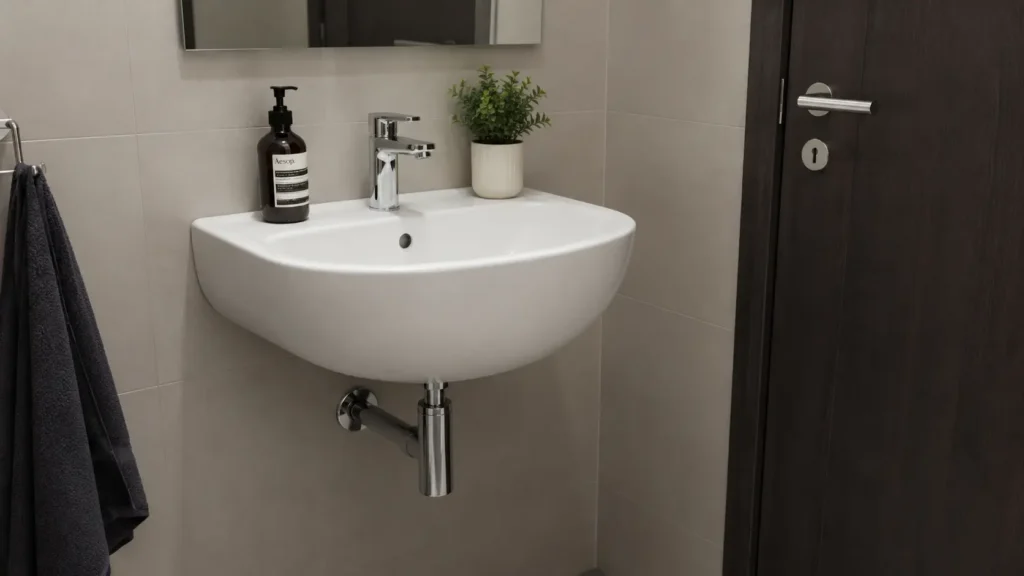
Mounts directly to the wall with no pedestal or cabinet underneath. This is the most space-efficient option and suits the compact attached bathrooms common in Indian flats (typically in the 5×8 ft to 6×8 ft range). Because the full weight hangs off the wall, it needs a solid wall or a reinforced mounting bracket.
2. Corner Basin
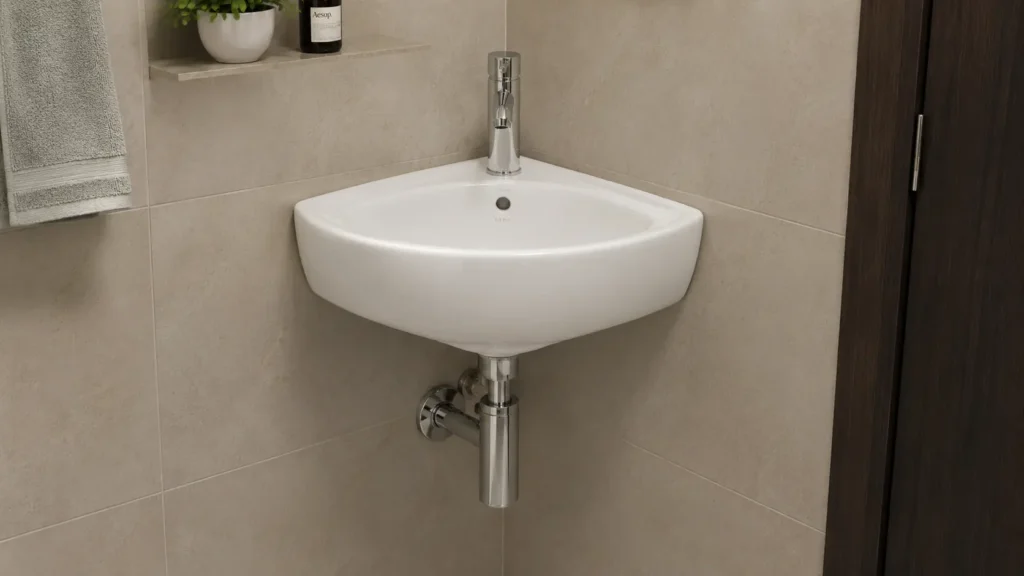
Shaped to tuck into a corner rather than sit against a flat wall. Useful when no straight wall section is free. Common in guest toilets and powder rooms. It saves the corner space specifically; a shallow wall-hung basin can sometimes have an even smaller overall footprint, so compare both before deciding.
3. Half-Pedestal Basin
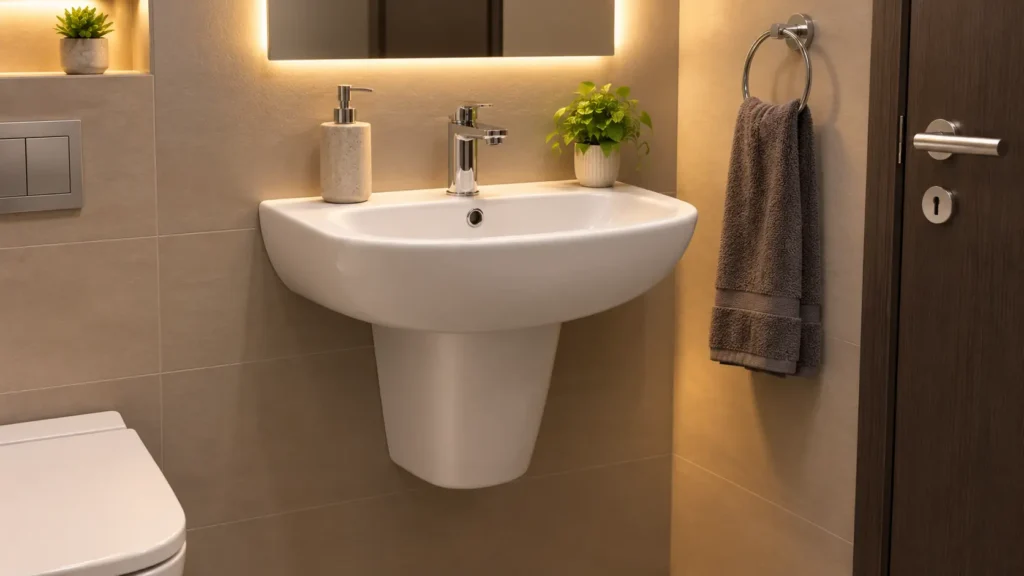
Sits on a short pedestal that covers only the plumbing, not the full floor-to-basin run. It gives a neater look than an exposed trap, without the floor footprint of a full pedestal.
Note: a half-pedestal hides the pipework but usually doesn’t reduce how far the bowl itself projects from the wall.
4. Under-Counter Basin
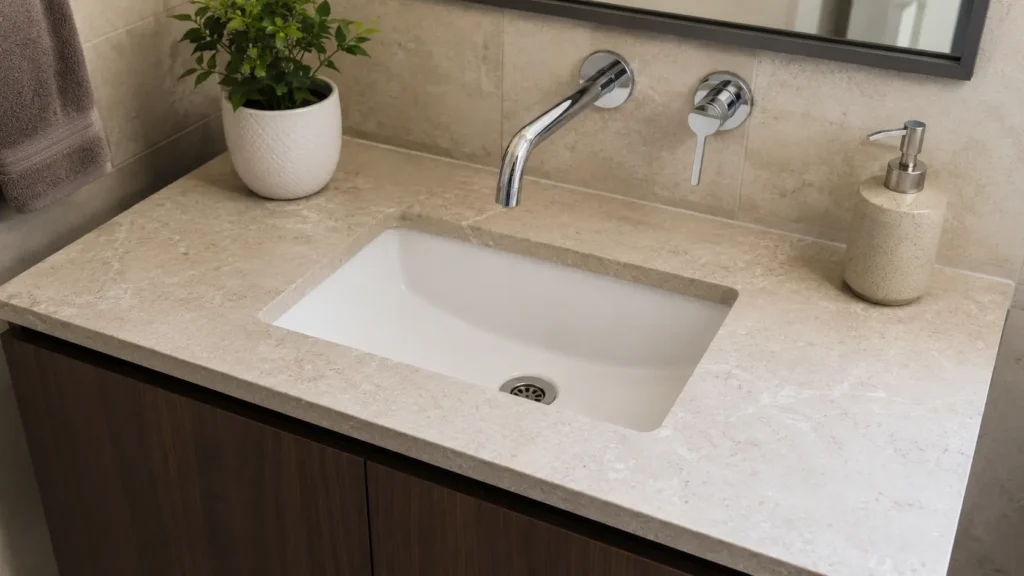
Mounted below a counter or vanity top for a seamless surface. It needs more counter depth than a wall-hung basin (typically 450 mm or more), and the bowl and plumbing underneath reduce usable cabinet storage; so it isn’t automatically the “storage-friendly” option it looks like on paper.
5. Countertop (Table-Top) Basin
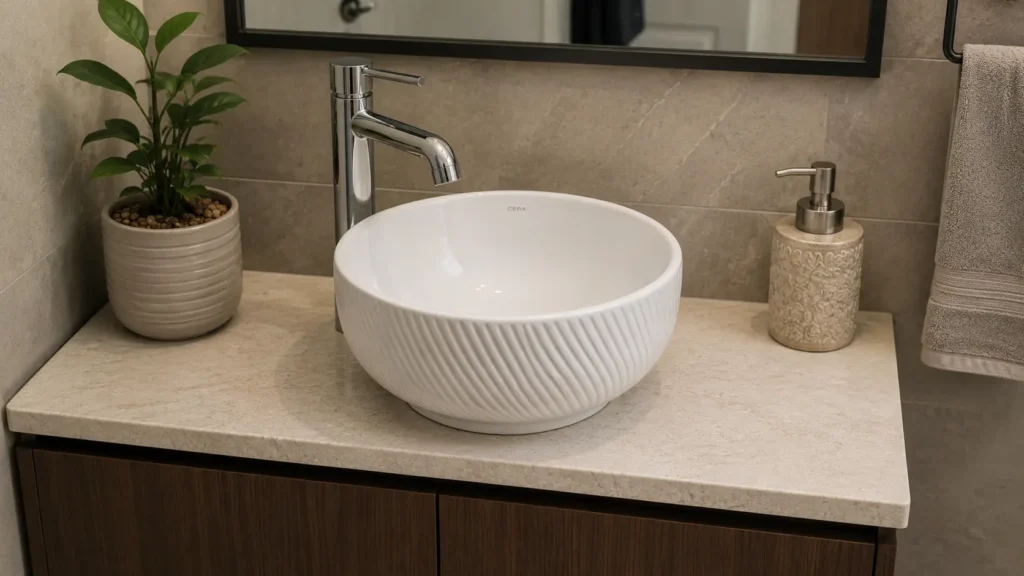
Sits on top of the counter. Many models need only a drain cut rather than a full cutout, which simplifies installation, but not all: some vessel-style basins still need a tap-hole template or extra counter reinforcement, so confirm the installation requirements for your specific model before buying.
Wash Basin Sizes for Small Indian Bathrooms
Getting the size right matters more than the brand. Most compact attached bathrooms in Indian apartments fall in the 5×8 ft to 6×8 ft range, though this varies by builder. Whatever your layout, leave room for the door swing, the toilet, and a comfortable walking path.
All dimensions below are labeled as Width × Projection (Depth) × Height, since manufacturer listings often mix these up.
| Basin Type | Practical Width | Practical Projection (Depth) | Notes |
| Wall-hung / compact | 350–500 mm | 250–350 mm | Ultra-shallow (100–200 mm) models exist but tend to splash more. |
| Corner basin | 350–450 mm along each wall | Varies by shape | Measure the diagonal/front clearance, not just the side lengths. |
| Half-pedestal | 450–550 mm | 300–450 mm | Hides plumbing; doesn’t usually reduce bowl projection. |
| Full pedestal | 450–600 mm | 350–500 mm | Neatest plumbing cover, but the largest footprint of the four. |
| Countertop | 350–500 mm | 300–400 mm | Also confirm your vanity/counter has enough depth. |
| Under-counter | 400–550 mm | Needs 450 mm+ counter depth | Not ideal for very tight bathrooms unless the vanity is already deep enough. |
Clearances to keep in Mind
- Leave at least 20–24 inches of clear floor space in front of the basin; 24–30 inches is more comfortable where space allows.
- Make sure the basin doesn’t block the bathroom door’s swing path.
- Keep at least 15–18 inches between the basin’s nearest edge and the toilet bowl’s centerline (the imaginary line running through the middle of the toilet).
- Confirm your existing plumbing inlet lines up with the basin’s tap-hole position, or budget for extra pipework.
- Standard installed rim height in Indian homes is 32–34 inches from the floor. For a countertop basin, remember the counter itself has to sit lower so the finished rim lands in this range.
A deeper bowl at the same width holds water better and splashes less; useful in Indian households where the basin often doubles up for light laundry or face-washing.
Wash Basin Brands and Products for Small Bathrooms in India
The products below are commonly available in India across budget, mid-range, and premium tiers.
We shortlisted them by comparing footprint, installation type, and price spread. We prioritized models with a projection under roughly 350 mm and confirmed availability from established Indian sanitaryware brands.
Treat the prices as indicative starting points, not final quotes: confirm current pricing, exact dimensions, tap-hole type, and warranty terms directly with the brand or your dealer before purchase.
Wall-Hung Basins
| Product | Size (W × Projection × H) | Indicative Price | Best For |
| Hindware Compact 10004 | 45 × 30 cm | ₹1,270–1,690 | Budget buyers with narrow wall runs; has a side semi-punched tap hole, which may need opening by a plumber depending on left/right installation. |
| Parryware Atom Plus | 400 × 300 × 110 mm | ₹1,550–1,750 | Smallest footprint among entry-level options. |
Compact Pedestal Basin
| Product | Size (W × Projection × H) | Indicative Price | Best For |
| Jaquar Sware Continental | 550 × 400 × 195 mm | ₹2,700–3,200 | Buyers who want plumbing fully hidden by a full pedestal |
Corner Basins
| Product | Size (W × Projection × H) | Indicative Price | Best For |
| CERA Corner | 400 × 400 mm | ₹2,150–3,250 | Guest toilets, low-maintenance bathrooms. |
| Hindware Corner (Cat. 10031) | 45 × 39 cm | ₹1,800-2300 | Tight, L-shaped layouts on a smaller budget. |
Countertop Basins
| Product | Size (W × Projection × H) | Indicative Price | Best For |
| Ruhe Icon Table-Top | 18 × 13 × 5 in | ₹5,300–8,200 | Bathrooms with a floating vanity that want a visible bowl. |
| CERA counter-basin range | Varies by model | ₹2,000–15,000 | Buyers who want a choice of materials across a wide budget. |
Before you buy any of these, ask the dealer to confirm: the exact tap-hole type (center, side, semi-punched, or none), whether an overflow is included, the warranty period and what it covers, and what accessories are bundled versus sold separately (pedestal, mounting brackets, waste coupling, bottle trap, tap, angle valves).
Installation labor for a plumber typically adds ₹500–₹1,500 to your total, though this can be higher if the job needs counter cutting, extra masonry, or additional brackets; get an itemized quote rather than assuming the basic range covers everything.
Things to Check Before Buying a Wash Basin for a Small Bathroom
- Measure your wall space in two directions: Note both width and projection, not just width.
- Check your plumbing inlet position: The new basin’s tap hole must line up with your existing pipe, or you’ll need rework.
- Pick a material for your maintenance tolerance: Ceramic resists stains and wipes clean easily, though the glaze can still chip from a hard impact. Glass looks striking but shows water spots and fingerprints faster.
- Confirm wall strength for wall-hung basins: These need a solid wall or a reinforced bracket, since there’s no pedestal to share the load.
- Compare warranty periods: Many branded basins offer 5–10 years on the ceramic body; verify the current term with the brand, since coverage details vary.
- Choose a finish suited to your water: No basin is fully hard-water-proof, but a smooth, glossy glaze shows mineral deposits less than a matte finish and is easier to wipe down.
- Budget for installation separately from the basin price: Factor in the plumber’s labor and any accessories not included in the box.
Summing It Up
Choosing the right wash basin for a small bathroom comes down to three checks: your available wall space (width and projection), your daily use, and your budget. A wall-hung basin gives the best overall balance of space-saving and style for most small Indian bathrooms, while a corner basin wins in the tightest or most awkward layouts.
Once you’ve fixed the type and size, match it to a basin from a trusted brand, confirm the tap-hole and accessory details with your dealer, and you’ll have a basin that fits your bathroom and lasts for years.
Frequently Asked Questions
Which Wash Basin Saves More Space: Wall-Mounted or Corner?
It depends on the model. A corner basin makes use of an otherwise wasted corner, which is why it’s the top pick for awkward layouts. But a shallow wall-hung basin can sometimes have a smaller overall footprint than a corner unit, so compare actual projection figures rather than assuming corner always wins.
What is the Standard Height of a Wash Basin in India?
Most homes install the basin rim at 32–34 inches from the floor. Homes with young children sometimes go slightly lower.
Is Ceramic or Glass Better for a Small Bathroom Basin?
Ceramic is the more practical everyday choice; it resists stains and needs less upkeep, though the glaze can still chip on hard impact. Glass looks stylish but shows water spots and fingerprints faster, so it needs more frequent cleaning.
How Do I Know If My Wall Can Support a Wall-Hung Basin?
Solid concrete or brick walls generally support a wall-hung basin without extra work. For lightweight or hollow walls, ask your plumber to fit a reinforcement bracket first.
Do Small Basins Need a Different Tap?
Not strictly, but a shorter-neck tap tends to suit a compact basin better. A tall, wide-spread faucet can look out of proportion and splash more on a smaller bowl.
Related Products
Explore products related to this article
-
 25%
25%Overhead Shower 10×10 Square AB3113 | MAZE By Begin
Original price was: ₹1,725.00.₹1,294.00Current price is: ₹1,294.00. Add to cart -
25%
Overhead Shower 10×10 AB3133 – Begin Faucets
Original price was: ₹1,550.00.₹1,163.00Current price is: ₹1,163.00. Add to cart -
25%
Matte Black LED Magnifying Mirror | Premium Bathroom Mirror
Original price was: ₹7,000.00.₹5,250.00Current price is: ₹5,250.00. Add to cart -
25%
Pixel Health Faucet Set AB0153 | Begin Faucets
Original price was: ₹770.00.₹577.00Current price is: ₹577.00. Add to cart