
Table Top vs Wall Mounted Wash Basin: Which is Better 2026
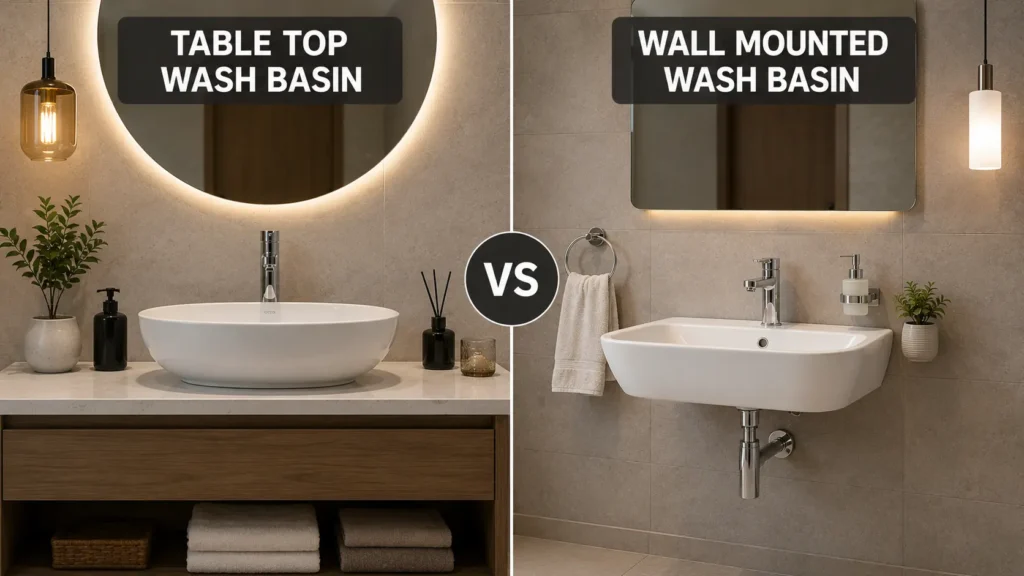
In India today, two styles dominate the shelves: the tabletop wash basin and the wall-mounted wash basin. So which one wins for your bathroom? That depends on a few things we’re about to unpack, including real space needs, plumbing, faucet type, and price. If your bathroom is small, go with a wall-mounted basin; it keeps the floor open and free. If you want a vanity with storage and a look that feels a bit more premium, a table top basin usually delivers that better. Most compact Indian bathrooms lean toward wall-mounted, while larger or master bathrooms often suit table-top basins. Table Top vs Wall Mounted Wash Basin: Quick Comparison Feature Table Top Wash Basin Wall Mounted Wash Basin Installation Sits on a counter or vanity Fixed directly to the wall Countertop needed Yes No Storage Vanity underneath can hold items Very limited Floor space Takes up more space Keeps the floor open Cleaning Wipe the counter and base Mop the open floor easily Design style Bold, decorative Simple, minimal Best for Large or master bathrooms Small or compact bathrooms Starting price in India Around ₹1,200 Around ₹1,000 What is a Table Top Wash Basin? Think of a bowl sitting on a table, and you’ve basically pictured a table top wash basin. It rests on top of a counter or vanity rather than being built into it, which is why some people call it a vessel sink or a countertop basin. Pros of Countertop Wash Basin Cons of Countertop Wash Basin What is a Wall Mounted Wash Basin? A wall mounted wash basin, sometimes called a wall hung basin, skips the counter altogether and bolts straight into the wall. No vanity required underneath. Pros of Wall Mounted Wash Basin Cons of Wall Mounted Wash Basin Faucet Compatibility While Choosing Wash Basin Here’s a mistake a lot of buyers make. They pick the basin first, love the look, and only think about the tap once the basin is already home. That order can backfire. A table top basin usually calls for a tall basin mixer or a wall mounted tap. Since the basin sits higher up on the counter, a short tap might not even reach the water properly into the bowl. A wall-mounted basin is more flexible here. It can work with a deck-mounted basin mixer, a wall-mounted faucet, or a single-hole tap, depending on what tap holes the basin comes with. Because the basin height gets fixed during installation, it’s actually simpler to plan where the tap should sit. Before you commit to either basin, check the tap holes, the spout reach, and your home’s water pressure. That small check now can save you an expensive fix later. Which One Should You Choose: Wall Mounted or Table Top Wash Basin Truth is, there’s no universal winner. It comes down to your bathroom’s size, your budget, and how you actually use the space day to day. Table Top Might Be Right If: Wall Mounted Might Be Right If: A Quick Reference Table Your Situation Better Choice Small bathroom Wall mounted Need vanity storage Table top Want maximum floor visibility Wall mounted Premium or designer bathroom Table top Rented home or PG Wall mounted Family bathroom with shared use Depends on storage needs Priority on easy floor cleaning Wall mounted Want a statement piece Table top Two things are easy to overlook here. First, a table top basin doesn’t automatically mean a taller setup. The finished rim height is the counter height plus the basin height added together, so a deeper vessel basin often needs a lower counter to stay comfortable. Second, a wall-mounted basin saves floor space but not wall space. It still projects outward from the wall, so in a narrow bathroom, that measurement matters if you don’t want it blocking the door or shower entry. Price Comparison in India Money is usually what tips the decision for most Indian households. The figures below reflect indicative online prices checked in 2026. Treat them as a starting point rather than a fixed number, since brand, finish, size, retailer, and ongoing discounts all move the price around. The basin price alone doesn’t tell the full story, though. The real installed cost includes the basin, faucet, waste coupling, trap, and labour. Add a countertop or vanity if you’re going table top. A wall-mounted basin skips that expense but might need extra wall reinforcement instead. It’s worth asking your dealer or plumber for a full quote before deciding, rather than comparing basin prices alone. Popular Brand Options in India for Wall Mounted and Table Top Wash Basins Basin Type Brand and Model Approx. Price Table Top Hindware Evita (Cat. 10101) ₹1,850 – ₹3,425 (varies by retailer/finish) Table Top Hindware Etios ₹2,999 – ₹4,165 Table Top Hindware Cora (Cat. 91203) ₹8,400 – ₹8,920 — confirmed close to original figure Table Top / Counter CERA Clair / Camry / Concord ₹2,000 – ₹15,000 (CERA’s own stated range for its counter basin line) Wall Mounted Parryware Wall Hung Basin (e.g. Cascade Classic, Vista) ₹2,000 – ₹8,500 (varies widely by model/size; no single official range published) Wall Mounted CERA Wall Hung Range ₹1,500 – ₹8,000 (broad range across models; CERA doesn’t publish one fixed band) Wall Mounted / Semi-Recessed Jaquar JDR Semi-Recessed Basin (JDS-WHT-25501) ₹5,400 – ₹9,600 (retailer prices vary significantly — several list it above ₹9,000) Quick note on that last one: the Jaquar JDR 25501 is a semi-recessed model, a hybrid that sits partly in a counter cut-out. It isn’t a direct table top or wall mounted match, but it’s worth knowing about if you want a middle ground. These brands have solid dealer networks across Indian cities, which counts for something when you need service or spare parts years down the line. As always, confirm current pricing before you buy, since these numbers shift. Things to Check Before You Buy a Wash Basin Run through this list before you finalize anything: Small checks like these prevent big headaches during installation. Final Thoughts At the
How to Install a Tabletop Wash Basin: Steps & Tips 2026
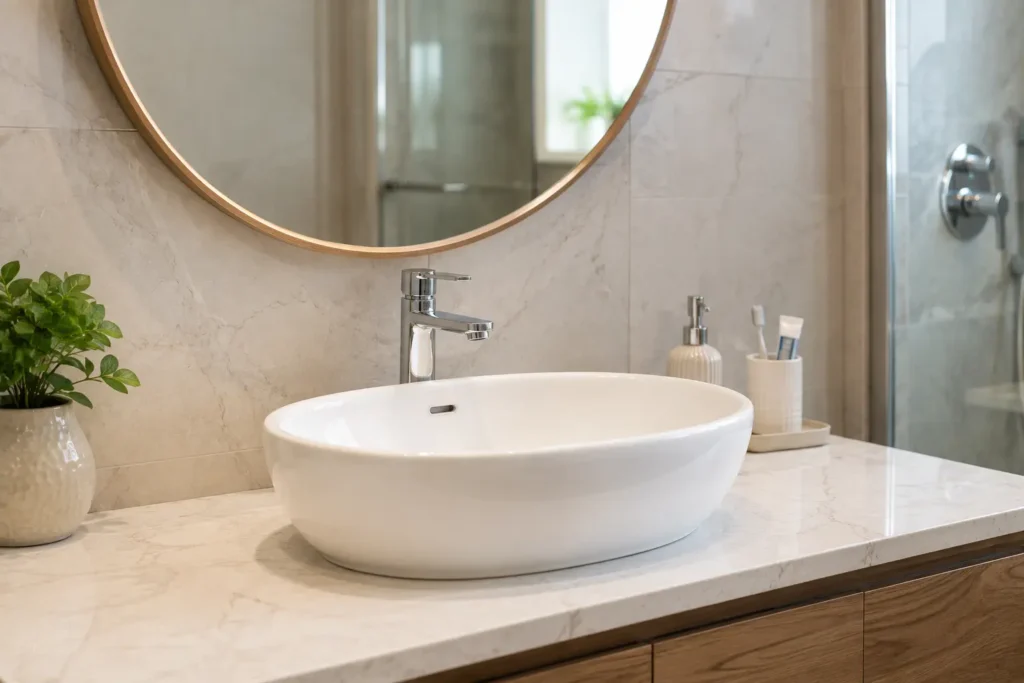
A tabletop wash basin looks simple to fit. But most leaks, wobbly basins, and splash problems in Indian bathrooms trace back to a few avoidable mistakes. Get the height right, pick the correct waste coupling and trap, and seal it properly, and the basin will serve you for years. To install a table top wash basin, work out your counter height based on the basin’s own height, mark the drain position, cut the counter as per the manufacturer’s template, fit the tap, fit the waste coupling, apply sealant, place and level the basin, connect the trap and water lines, test for leaks, and let the sealant cure for about 24 hours before use. This guide covers what to check before you start, the tools you need, the full process, how to pick the right waste and trap, common mistakes, and cost in India. What is a Table Top Wash Basin A table top wash basin sits on top of a counter or vanity instead of being built into the wall or under the counter. It looks like a bowl placed on a table, which is where the name comes from. You will also see it called a countertop basin or a vessel basin. This style is popular in Indian homes because it gives a clean, hotel-like look and frees up storage space below the counter. It is also easier to replace later than a wall-hung basin if you want to change your bathroom design. Planning the Right Height for Your Wash Basin Before Installation Since the basin sits above the counter, the finished rim ends up taller than the counter itself. Build the counter at the same height as a normal vanity, and the basin may sit too high for comfort. Use this Simple Method: Counter height equals your target rim height minus the basin’s own height. For example, if you want a certain rim height and know how much the basin adds on top of the counter, subtract that basin height to get your counter height. The exact basin height varies by model, so always check the product’s spec sheet before fixing your counter height. This one check prevents most comfort complaints later. Things to Check Before You Start Installing Counter Wash Basin Tools and Materials You Need A Note on Sealant: Neutral-cure silicone is the safer choice for bathrooms, since it will not corrode metal fittings or discolour natural stone the way some acid-cure sealants can. Acid-cure types bond well to plain ceramic and glass but are best avoided near stone counters and metal fixtures. Steps to Install a Tabletop Wash Basin Step 1: Turn off the water supply at the isolation valves before touching any pipework. Step 2: Mark the position. Decide where the basin sits and mark the centre line, leaving enough space on both sides for comfortable use. Step 3: Cut the hole, if needed, using the manufacturer’s template. Go slow, especially on stone. Step 4: Dry-fit the basin to check alignment with the waste outlet. Step 5: Fit the tap first. It is easier to tighten from below before the basin is in place. Step 6: Fit the waste coupling. Place the gasket and tighten it into the drain hole. Most Indian basins use a 32mm waste coupling, but check your basin’s spec sheet to confirm. Step 7: Apply sealant. Run a smooth, even bead of neutral-cure silicone where the basin meets the counter. A thin, even line seals as well as a thick one and looks neater. Step 8: Place and level the basin, checking with the spirit level. Step 9: Connect the trap, keeping it straight and aligned with the wall drain, not angled. Step 10: Connect the water supply with flexible hoses, then turn the water on slowly and check every joint for drips. Step 11: Let the sealant cure, usually around 24 hours, though this varies by product. Avoid heavy use until then. Choosing the Right Waste Coupling, Trap, and Tap Waste Coupling Check for a small overflow hole near the basin’s top rim. If it has one, use a slotted waste coupling, which lets overflow water drain safely. If there is no overflow hole, use an unslotted waste coupling. Fitting the wrong type can cause leaks or make the overflow useless. Trap Type A bottle trap is common with table top basins in India, since it looks neat where plumbing is visible and takes less space. If your drain line is concealed inside a vanity or wall, a P-trap works just as well and can be easier to clean. What matters most is that the trap sits straight, holds water to block drain smells, and stays accessible for cleaning. Tap Choice A tall body basin mixer or wall-mounted spout usually suits a table top basin better than a short tap, since a short tap may not reach the bowl’s centre and can cause splashing. A tap set too high above a shallow basin causes the same problem. Check the spout’s height and reach against your basin’s depth before buying. Common Mistakes to Avoid DIY or Call a Plumber If your plumbing points are ready and the cut-out is done, installing the basin yourself is manageable with basic tools and patience. Many homeowners in India do this successfully. Hire a professional if you are cutting a stone counter, setting up new plumbing lines, or fitting the vanity and basin together for the first time. A mistake with stone cutting can be costly to fix. Troubleshooting and Maintenance Tips If something is not working right after installation, use this table to find the likely cause. Problem Likely Cause Basin feels wobbly Sealant has not cured, or the basin was not levelled before it set. Water splashes outside the bowl Tap’s spout height or reach does not match the basin’s depth. Slow drainage Trap is blocked, or the waste coupling is the wrong size. Bad smell from the drain Trap is not holding water properly. Leak under the basin Sealant line
Wash Basin Size Guide for Indian Homes 2026
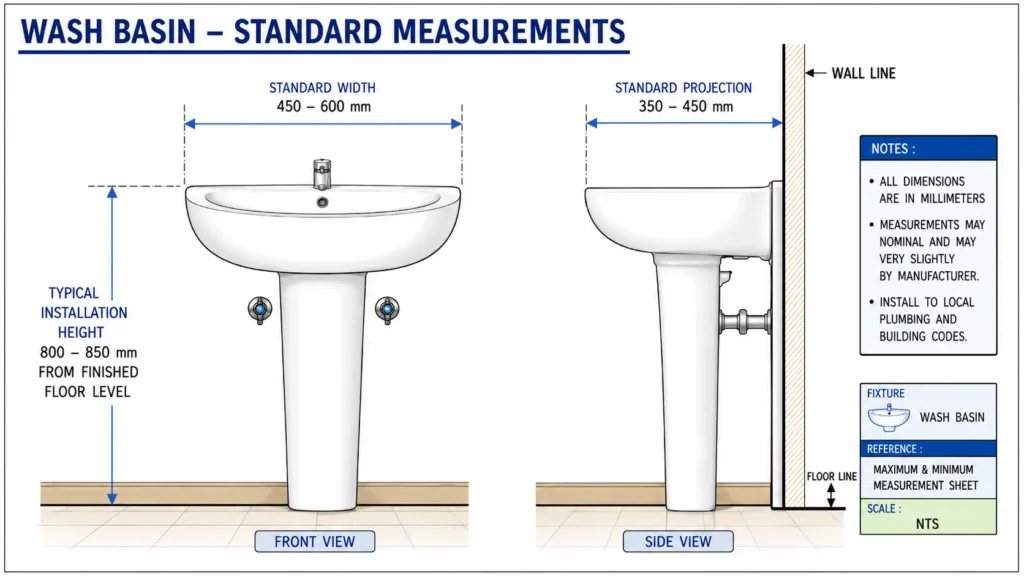
Choosing the right wash basin size is not just about looks. The wrong size can crowd your bathroom, splash water, or leave you stooping every morning. This wash basin size guide India covers common dimensions, basin types, and buying advice, so you can measure once and buy right. Most standard wash basins sold in India are around 450–600 mm (18–24 inches) wide, with a projection of roughly 350–450 mm (14–18 inches) from the wall. Installation height typically falls between 800 and 850 mm (32–34 inches) from the finished floor, though the ideal height depends on the basin type and the people using it. This guide gives sizes in millimetres, centimetres, and inches, because Indian plumbers and tilers work in mm while most buyers still think in inches. Standard Wash Basin Size in India (mm, cm & inches) Before you shop, know the four numbers that matter most: width, projection, bowl depth, and height. These are typical market ranges based on commonly sold basins, not fixed rules. Measurement mm cm inches Width 450–600 45–60 18–24 Projection (wall to front edge) 350–450 35–45 14–18 Bowl depth (top to lowest point) 120–200 12–20 4.7–8 Installation height from floor 800–850 80–85 32–34 A basin within this range fits most Indian bathrooms without needing custom plumbing work. Brand size reference: Parryware’s wall-hung range alone spans 450×330×210 mm, 500×400×210 mm, and 570×440×200 mm models, all within the ranges above. When shortlisting, check the size chart on the brand’s own product page (Cera, Hindware, Parryware, Jaquar, and Kohler all publish these) rather than relying on the showroom display model. What Do Wash Basin Dimensions Mean? Product listings often use these terms loosely: Knowing these terms prevents the most common ordering mistake: the right width paired with the wrong projection. Wash Basin Size Chart by Type Different basin types come in different size ranges. Use this table to match a type to your bathroom layout before you check the price tag. Basin Type Typical Width (mm) Best For Notes Corner basin 350–450 Very small or awkward-shaped bathrooms Fits into unused corners; limited storage below Wall-hung 450–600 Small to medium bathrooms, modern homes Easy to clean underneath; needs strong wall support Pedestal 450–550 Traditional Indian bathrooms Hides plumbing pipes; limited counter space Countertop / tabletop 400–550 Bathrooms with a vanity counter Sits above the counter, so total height increases Under-counter 400–500 Modern vanities with storage Rim sits flush with counter for easy wiping Semi-recessed 450–550 Narrow bathrooms Half the basin sits inside the counter to save projection Large / double vanity 900–1200 (combined) Shared or master bathrooms Two basins for couples or family use; combined width, not per-basin Recommended Wash Basin Size by Bathroom Size (Planning Guide) These ranges are practical planning recommendations, not fixed standards. Your final basin size still depends on door swing, WC position, shower enclosure, and where the drain outlet already sits. Bathroom Size Recommended Basin Width Best Type Powder room (below 4×4 ft) 400–450 mm Corner or compact wall-hung Small bathroom (4×6 ft) 450–500 mm Wall-hung or semi-recessed Standard bathroom (5×7 ft) 500–550 mm Wall-hung or pedestal Large bathroom (6×8 ft) 550–600 mm Countertop or under-counter Master bathroom (8×10 ft or above) 600 mm and above, or double vanity Large countertop or double basin For comfortable planning, aim for 100–150 mm of clearance between the basin and the nearest wall or fixture, where your layout allows it. Always cross-check this against the basin’s installation template before finalising the plumbing points. Wash Basin Size vs Vanity Size A basin only works well when the vanity below it is wide enough. A tight vanity leads to splashed water, cluttered counters, and a basin that looks out of place. Basin Width Minimum Vanity Width Needed 450 mm 600 mm 500 mm 650 mm 550 mm 700 mm 600 mm 750 mm The vanity is typically around 150 mm wider than the basin overall, which works out to roughly 75 mm of extra space on each side when the basin sits centered. Treat this as a practical starting point rather than a fixed rule; the exact figure depends on the basin’s mounting method and the manufacturer’s own template. Standard Wash Basin Height & Installation Clearances BIS quality norms for ceramic sanitaryware (IS 2556) cover glaze, strength, and finish, not a single fixed installation-height clause. The 800–850 mm figure is accepted industry practice among Indian architects and plumbers, and it suits most adult users. To know more about wash basin height, check out this blog: [Wash Basin Height Guide]. What to Measure Before You Buy a Wash Basin This step saves the most returns and site delays. Before you order, note down: wall width, available projection, intended rim height, drain and water inlet locations, faucet hole configuration, counter cut-out size (for counter basins), door swing clearance, and distance from the WC. Share these with the seller before you finalise a model. How to Choose the Right Wash Basin Size A simple flow: measure wall width and projection first, shortlist a type that fits, then match it to your drain and faucet configuration. Limited projection usually points toward a compact wall-hung or semi-recessed basin over a full pedestal. Common Wash Basin Size Mistakes to Avoid Even careful buyers slip up on a few common points: Final Thoughts The right wash basin size depends on your bathroom footprint, vanity width, and how the space is actually plumbed, not on looks alone. Use the tables above to shortlist a range, measure against the checklist, then verify exact dimensions on the manufacturer’s product page before you buy. A little measuring now saves you a return or a redo later. Frequently Asked Questions What is the Standard Wash Basin Size in India? Most basins sold in India fall between 450 and 600 mm wide, with a projection of 350 to 450 mm and a bowl depth of 120 to 200 mm. These are common market ranges rather than a single fixed number. Which Wash Basin Size is Best for a Small Bathroom? For
Standard Wash Basin Height From Floor (810–860mm)
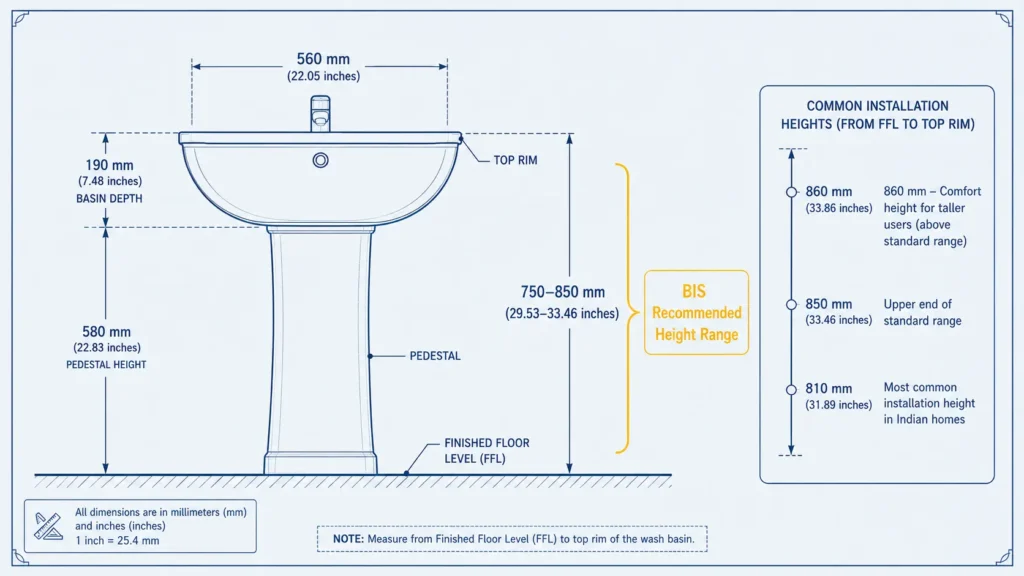
The practical wash basin height for most Indian bathrooms is 810 to 850 mm (32 to 33.5 inches) from finished floor level to the basin rim — inside the official BIS range of 750 to 850 mm. Some modern vanity setups go up to about 860 mm for taller users, but that is a comfort choice, not a BIS-backed figure. Picking the right wash basin height is not a small detail. A basin that sits too high forces you to stretch. One that sits too low makes you bend your back. Neither feels good, and both can cause pain over time. This guide gives you the exact numbers, backed by the official BIS standard, plus how height changes for wall-mounted, pedestal, and countertop basins. What is the Standard Wash Basin Height From Floor? The Bureau of Indian Standards, under IS 2556 Part 4, covers vitreous china wash basins. Its Figure 7 specifies that a pedestal wash basin’s floor-to-top-rim height should fall between 750 and 850 mm. In real installations, most people settle around 810 to 850 mm, since this fits both the BIS range and the average adult user. Some modern vanity designs push the rim closer to 860 mm for taller households, but that sits slightly above the BIS upper limit — a comfort adjustment, not a standards-backed figure. In inches, the BIS range works out to roughly 29.5 to 33.5 inches, with 32 to 33.5 inches being the most common practical choice for bathroom sink height in Indian homes. This measurement always starts from the finished floor level, or FFL. The finished floor is the surface you walk on after tiles and flooring are laid. It is not the raw concrete slab underneath. The height is measured up to the top of the basin. This is the rim you actually touch and use each day. Getting this reference point right prevents costly mistakes during installation, and it applies whether you call it a basin, a lavatory, or simply a sink. Wash Basin Height Chart in mm, cm, and Inches Use this table as a quick reference. Heights up to 850 mm fall within the BIS range; 860 mm is a taller-user comfort figure, not a BIS number. Height in mm Height in cm Height in inches Within BIS range? 810 81 31.9 Yes 830 83 32.7 Yes 850 85 33.5 Yes (upper limit) 860 86 33.9 No — 10 mm above A height of 830 mm works well for most families, sitting comfortably inside the BIS range for both shorter and taller adults. Wash Basin Height by Type Not every basin follows the same rule. The type of basin you choose changes how you should measure and install it. Wall-Mounted Basin Height A wall-mounted basin attaches directly to the wall, with no cabinet or pedestal underneath. You can fix it at any height, but 810 to 850 mm to the top rim keeps you within the BIS range and works well for most adults. This type gives you the most freedom during installation, since you set the exact height yourself. Pedestal Basin Height A pedestal basin comes with a fixed stand that supports the basin and hides the plumbing pipes. Since the height is often set by the manufacturer, check the product’s installation sheet first. Most pedestal basins are designed to land within the BIS-specified 750 to 850 mm range. Countertop or Vessel Basin Height This is where many people go wrong. A vessel basin sits on top of the counter instead of being built into it, so its bowl adds extra height on its own. Placing a vessel basin on a standard-height counter often pushes the final height too tall. Use this formula to get it right: Final basin height = Counter height + Basin height above the counter For example, if your vessel basin adds 150 mm, keep the counter around 680 mm. This keeps the final usable height at 830 mm, comfortably inside the BIS 750–850 mm range. Under-Counter Basin Height Here, the basin sits below the counter, and you use the counter itself as your washing surface. The finished countertop height matters most, so aim for 810 to 850 mm at the countertop level to stay within the BIS range and keep good comfort. Vanity Basin Height A vanity combines a cabinet, a countertop, and a basin. The final height depends on all three parts added together. Before you buy a cabinet, check the combined height of all three, so you avoid an uncomfortable setup later. Is 32 Inches or 34 Inches the Right Height? Only one of these sits fully inside the BIS range: The number that matters most is the final height of the basin’s top surface, not the cabinet or counter alone. Wash Basin Height for Different Users One height does not fit every household member. Here is a practical starting guide: User Group Suggested Approach Adults 810–850 mm works well and stays within BIS Children Use a lower basin, or add a sturdy step stool Elderly users Keep the height comfortable to avoid extra bending Wheelchair users Needs a lower, obstruction-free setup with knee clearance Treat these figures as helpful starting points rather than fixed rules, and adjust based on actual comfort. For wheelchair access, India’s RPWD Act, 2016, along with the CPWD Harmonised Guidelines, requires knee and foot clearance underneath the basin. The exact rim height for accessible basins varies across reference documents and project type, so rather than quote a single number here, plan this with an architect or accessibility consultant for public or shared spaces, and confirm the current figures in the applicable guideline before finalizing. How to Measure Wash Basin Height Correctly Follow these steps to avoid a common and costly mistake: Skipping step one is the most common mistake. A finished bathroom floor, with tiles, adhesive, and screed, typically adds 60 to 80 mm over the raw concrete slab. Measure before this layer goes down, and the finished basin ends up lower than planned.
Best Wash Basin for Small Bathroom in India 2026
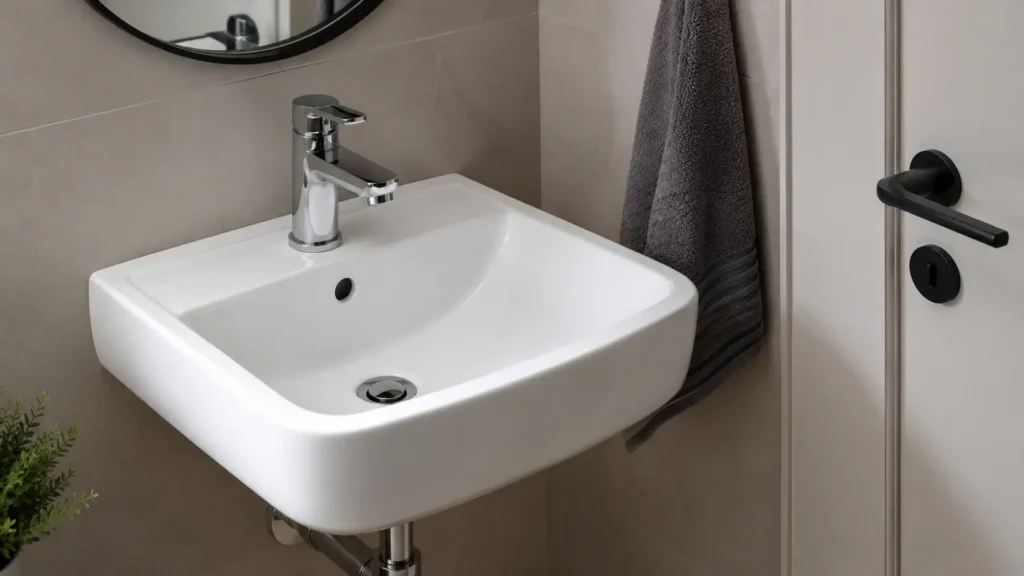
For most small Indian bathrooms, a wall-hung basin is the best all-round choice; it frees up floor space and makes the floor easier to mop. If your bathroom is very tight or has no free straight wall, a corner basin is usually the better fit. Here’s the quick verdict: The one thing to note is that people focus on basin width and ignore projection (depth)- how far the bowl sticks out from the wall. Projection is usually the number that decides whether a basin blocks your door swing or crowds your shower. A narrow basin that projects deeply can eat up more usable floor space than a wider, shallower one. Always check projection first, then width. Types of Wash Basins That Work Well in Small Bathrooms 1. Wall-Hung Basin Mounts directly to the wall with no pedestal or cabinet underneath. This is the most space-efficient option and suits the compact attached bathrooms common in Indian flats (typically in the 5×8 ft to 6×8 ft range). Because the full weight hangs off the wall, it needs a solid wall or a reinforced mounting bracket. 2. Corner Basin Shaped to tuck into a corner rather than sit against a flat wall. Useful when no straight wall section is free. Common in guest toilets and powder rooms. It saves the corner space specifically; a shallow wall-hung basin can sometimes have an even smaller overall footprint, so compare both before deciding. 3. Half-Pedestal Basin Sits on a short pedestal that covers only the plumbing, not the full floor-to-basin run. It gives a neater look than an exposed trap, without the floor footprint of a full pedestal. Note: a half-pedestal hides the pipework but usually doesn’t reduce how far the bowl itself projects from the wall. 4. Under-Counter Basin Mounted below a counter or vanity top for a seamless surface. It needs more counter depth than a wall-hung basin (typically 450 mm or more), and the bowl and plumbing underneath reduce usable cabinet storage; so it isn’t automatically the “storage-friendly” option it looks like on paper. 5. Countertop (Table-Top) Basin Sits on top of the counter. Many models need only a drain cut rather than a full cutout, which simplifies installation, but not all: some vessel-style basins still need a tap-hole template or extra counter reinforcement, so confirm the installation requirements for your specific model before buying. Wash Basin Sizes for Small Indian Bathrooms Getting the size right matters more than the brand. Most compact attached bathrooms in Indian apartments fall in the 5×8 ft to 6×8 ft range, though this varies by builder. Whatever your layout, leave room for the door swing, the toilet, and a comfortable walking path. All dimensions below are labeled as Width × Projection (Depth) × Height, since manufacturer listings often mix these up. Basin Type Practical Width Practical Projection (Depth) Notes Wall-hung / compact 350–500 mm 250–350 mm Ultra-shallow (100–200 mm) models exist but tend to splash more. Corner basin 350–450 mm along each wall Varies by shape Measure the diagonal/front clearance, not just the side lengths. Half-pedestal 450–550 mm 300–450 mm Hides plumbing; doesn’t usually reduce bowl projection. Full pedestal 450–600 mm 350–500 mm Neatest plumbing cover, but the largest footprint of the four. Countertop 350–500 mm 300–400 mm Also confirm your vanity/counter has enough depth. Under-counter 400–550 mm Needs 450 mm+ counter depth Not ideal for very tight bathrooms unless the vanity is already deep enough. Clearances to keep in Mind A deeper bowl at the same width holds water better and splashes less; useful in Indian households where the basin often doubles up for light laundry or face-washing. Wash Basin Brands and Products for Small Bathrooms in India The products below are commonly available in India across budget, mid-range, and premium tiers. We shortlisted them by comparing footprint, installation type, and price spread. We prioritized models with a projection under roughly 350 mm and confirmed availability from established Indian sanitaryware brands. Treat the prices as indicative starting points, not final quotes: confirm current pricing, exact dimensions, tap-hole type, and warranty terms directly with the brand or your dealer before purchase. Wall-Hung Basins Product Size (W × Projection × H) Indicative Price Best For Hindware Compact 10004 45 × 30 cm ₹1,270–1,690 Budget buyers with narrow wall runs; has a side semi-punched tap hole, which may need opening by a plumber depending on left/right installation. Parryware Atom Plus 400 × 300 × 110 mm ₹1,550–1,750 Smallest footprint among entry-level options. Compact Pedestal Basin Product Size (W × Projection × H) Indicative Price Best For Jaquar Sware Continental 550 × 400 × 195 mm ₹2,700–3,200 Buyers who want plumbing fully hidden by a full pedestal Corner Basins Product Size (W × Projection × H) Indicative Price Best For CERA Corner 400 × 400 mm ₹2,150–3,250 Guest toilets, low-maintenance bathrooms. Hindware Corner (Cat. 10031) 45 × 39 cm ₹1,800-2300 Tight, L-shaped layouts on a smaller budget. Countertop Basins Product Size (W × Projection × H) Indicative Price Best For Ruhe Icon Table-Top 18 × 13 × 5 in ₹5,300–8,200 Bathrooms with a floating vanity that want a visible bowl. CERA counter-basin range Varies by model ₹2,000–15,000 Buyers who want a choice of materials across a wide budget. Before you buy any of these, ask the dealer to confirm: the exact tap-hole type (center, side, semi-punched, or none), whether an overflow is included, the warranty period and what it covers, and what accessories are bundled versus sold separately (pedestal, mounting brackets, waste coupling, bottle trap, tap, angle valves). Installation labor for a plumber typically adds ₹500–₹1,500 to your total, though this can be higher if the job needs counter cutting, extra masonry, or additional brackets; get an itemized quote rather than assuming the basic range covers everything. Things to Check Before Buying a Wash Basin for a Small Bathroom Summing It Up Choosing the right wash basin for a small bathroom comes down to three checks: your available wall space (width and projection), your daily use, and your budget.
Bathroom Grab Bars for Elderly in India | Complete Guide
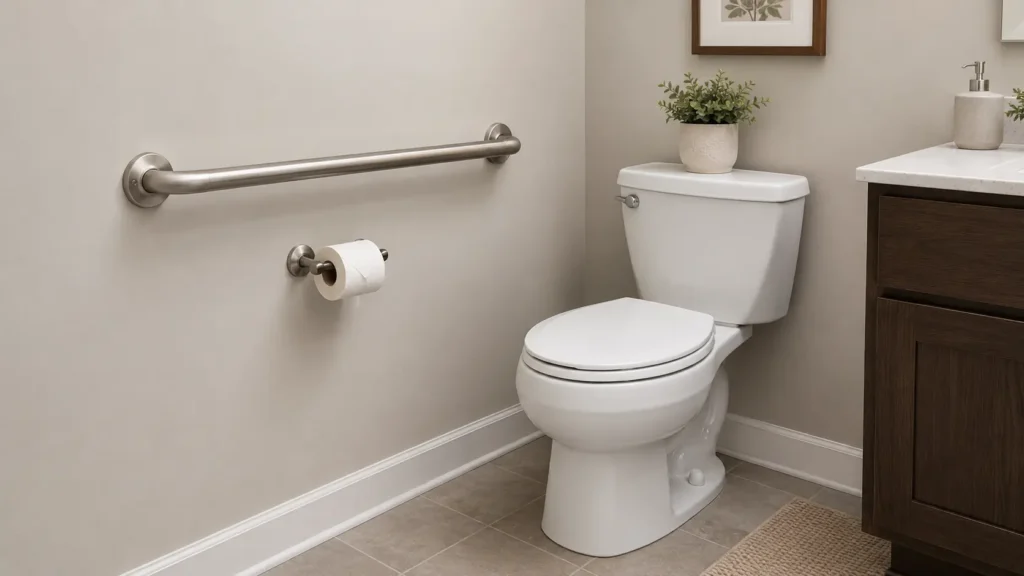
Walk into most Indian bathrooms, and you’ll find the same setup: a bucket and mug near a floor-level tap, wet ceramic tiles underfoot, and nothing on the wall to hold onto. Your parents use this bathroom alone, every morning, often while half-asleep and moving slower than they used to. That combination — standing water, hard tiles, and no support is exactly how most falls at home happen. Not on stairs. Not in the kitchen. In the bathroom. A grab bar is a small fix for a big risk. This guide covers what the data actually shows, where bars need to go, which type and size fit an Indian bathroom, what “correct height” really means here (not just the American number every site copies), and what the whole job realistically costs. Why Elderly Falls in Indian Bathrooms Are So Common This isn’t a guess — it’s backed by India’s largest study on ageing. The Longitudinal Ageing Study in India (LASI), a nationally representative survey of more than 28,000 adults aged 60 and above, found that about 11.6% of them reported a fall. Among older adults already classified as frail, that number climbs to roughly 15%, compared to under 12% for those who aren’t frail. Other regional studies in India have found even wider variation — anywhere from 14% to over 50% depending on the state and how the survey was conducted, which tells you fall risk isn’t evenly spread; it depends heavily on local conditions, age, and health status. The bathroom sits at the centre of this risk because Indian plumbing habits are structurally different from Western ones: None of these are unusual bathrooms; they’re the default layout in most Indian homes, which is exactly why this deserves more attention than it usually gets. Where You Actually Need a Grab Bar A grab bar only helps if it’s where the body actually moves. Think through the real path: door → across the wet floor → commode or bathing area → back to the door. Types of Grab Bars in India No single bar type fits every bathroom. Most homes end up using a mix. Type Best for What to know Straight bars Everyday commode and shower use The default option; mounted horizontal, vertical, or diagonal L-shaped / angled bars Corners, shower entries Combine a vertical and horizontal grip in one unit Folding / flip-up bars Compact Indian bathrooms Hinge flat against the wall when not needed — useful where space is tight Diagonal-mount bars Users with arthritis A 45° angle can follow the arm’s natural arc more comfortably than a flat horizontal bar Suction-cup bars Travel or short-term use only Not rated for full body weight — treat as temporary, never a daily-use substitute for a wall-anchored bar What Size Grab Bar Do You Need? Length should match the spot, not personal preference: As a rule of thumb: shorter near the commode, longer along shower walls and approach paths. Grab Bar Height: India vs. the ADA Numbers Most articles on this topic quote the American ADA standard of 33–36 inches (about 84–91 cm) from the floor, because it’s the most searchable number online. It’s a legitimate reference, but it’s a US commercial-building code, not something written for Indian homes or Indian body proportions. India does have its own accessibility framework: the Harmonised Guidelines and Standards for Universal Accessibility in India, 2021 (issued by the Ministry of Housing and Urban Affairs and CPWD under the Rights of Persons with Disabilities Act, 2016), along with the older IS 4963:1987 from the Bureau of Indian Standards. These are the correct reference points for Indian accessible design, and they exist primarily to guide public buildings rather than private homes. For a home installation, the more useful approach and the one geriatric and occupational therapists generally recommend is to mount the bar level with your parent’s hip height while they’re standing next to it, rather than defaulting to a fixed number pulled from a foreign code. A few centimetres of difference matters far more to the actual user than matching an imported standard exactly. Whatever height you choose, the bar must be anchored into a wall stud, brick, or solid concrete — never into tile or drywall alone. Stainless Steel, Nylon, or Aluminium: Which Material Should You Pick? The right material depends more on your local climate than on price. Material Best For Watch Out For SS304 stainless steel Humid and coastal climates; long-term daily use Higher upfront cost, but holds up where cheaper materials corrode Nylon/composite Budget installs, lighter use, warmer grip for arthritic hands Lower load capacity; can degrade faster in extreme heat Aluminium Lightweight installs Wears faster in high-humidity, coastal conditions For most Indian homes, especially anywhere near the coast or dealing with heavy monsoon humidity — SS304 stainless steel with a textured, non-slip grip is the safer long-term choice, even at a higher initial cost. What Affects Your Total Grab Bar Cost The bar itself is only part of the bill. Two things matter more: Product prices vary widely by brand, material, and load rating, so treat any single figure you see online as a rough guide rather than a fixed number — always confirm current pricing and the certified load rating directly with the seller before buying. As a general pattern, basic bars sit at the lower end of the market, while branded with anti-slip grips and higher load ratings cost noticeably more. It’s usually more cost-effective to budget for a full three-bar bathroom setup at once than to add bars one at a time later. If a parent is recovering from surgery and only needs support for a few months, renting is worth exploring — several home-care and mobility-equipment suppliers in India now offer short-term grab bar rentals as an alternative to buying. Installation and Buying Checklist Most grab-bar failures come down to poor installation, not a weak bar. Before you buy or install: Beyond Grab Bars: Building a Genuinely Fall-Safe Bathroom A grab bar alone doesn’t cover everything.
What is a Wash Basin Waste Coupling? Complete Guide
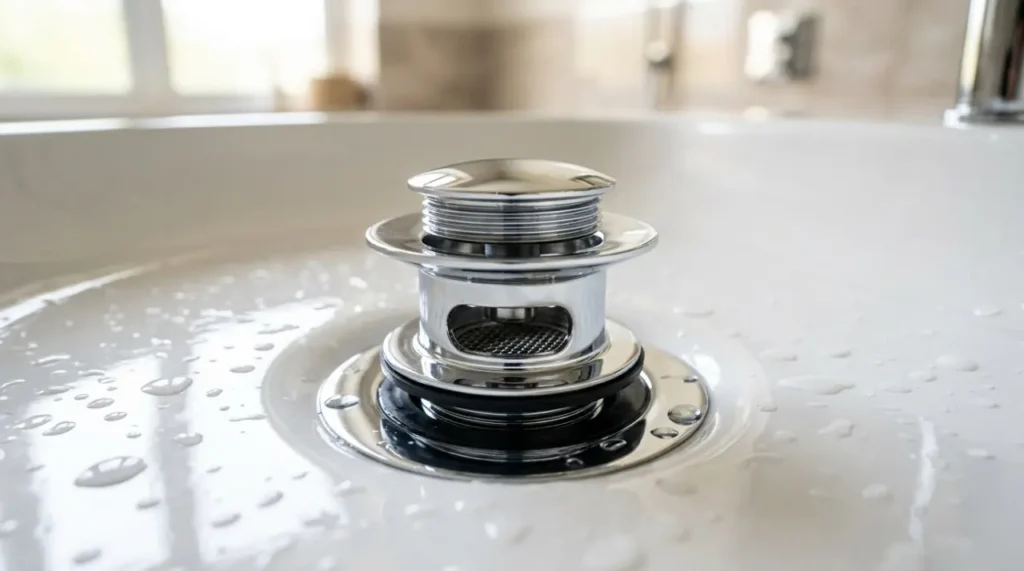
Water pooling under your basin. A drain that barely moves. A smell that won’t leave the bathroom. Most of the time, one small part is responsible, the wash basin waste coupling. People buy expensive basins, premium taps, and designer tiles. Then they fit a cheap coupling and wonder why things go wrong in 6 months. This blog covers types, sizes, materials, installation, and fixes — everything you need before you buy or before you call a plumber. What is a Wash Basin Waste Coupling and What Does It Contain? A wash basin waste coupling is a drain fitting that joins the outlet hole of a wash basin to the waste pipe below it, and which provides a seal to the joint to prevent leaks. Each Coupling is Made of 5 Parts: 1. Top Flange: The visible ring on the top of the basin drain. It acts as a strainer or jali to prevent hair and debris from entering the drain pipe. 2. Threaded Body: The cylindrical tube that goes through the drain hole in the basin and into the drain below. A full-thread body has threads along its entire length for more grip, while a half-thread body has threads only near the base and is used where there is limited space below the basin. 3. Overflow Slot: That notch on the side of the threaded body is what connects your basin’s overflow channel to the drain. A slotted coupling keeps that path open; an unslotted one seals it shut completely. Put an unslotted coupling in a basin built with an overflow hole, and water backs up inside the channel with nowhere to go. 4. Rubber Washer + Plastic Washer: These 2 washers sit between the basin’s underside and the locking nut. Their job is simple: stop water from pushing through the outlet hole and dripping below. No washer, no seal — it leaks from day one. 5. Locking Nut: The large nut is tightened from below the basin that clamps the entire assembly firmly in place. Types of Waste Couplings and Which One Fits Your Bathroom The type you need depends on two things — your basin design and how often the bathroom is used. Type How It Works Best For Not Suitable For Price Range (India) Open / Free-Flow No stopper; water drains freely at all times High-traffic bathrooms, utility areas, servant toilets Basins where water retention is needed (shaving, soaking) ₹60–150 Dome / Jali Perforated dome sits over the outlet; no moving parts Kitchen sinks, outdoor basins, high-debris areas Basins requiring water retention or a tight seal ₹80–200 Click-Clack / Push-Button Push down to close, push again to open Personal bathrooms, easy DIY replacement Basins with very shallow outlet depth; some vessel basins ₹250–600 Pop-Up The rod linkage connects to a lever near the tap; the tap handle opens and closes the drain Designer basins, premium bathrooms, wall-mount basins Basins with no pre-drilled overflow or linkage hole ₹500–1,500 Plug & Chain Rubber plug on a chain; needs a chainstay hole on the basin Vintage, classic, or clinic-style basins Modern basins without a chainstay anchor point ₹150–400 Waste Coupling Sizes and Materials Indian wash basins use a 32mm (1.25 inch) drain outlet as standard. Kitchen sinks use 40mm (1.5 inch) — these 2 sizes are not interchangeable, and fitting the wrong one creates a poor seal and a persistent leak from day one. To measure your drain hole, place a ruler across the widest internal diameter of the outlet opening. That number decides which wash basin waste coupling goes in. Waste Coupling Materials In Indian cities with high TDS water, SS304 or solid brass are the only materials worth using in a primary bathroom. How to Choose the Wash Basin Waste Coupling Before purchasing, run through these 5 steps in order. 1. Check Your Basin Type: Pedestal basins have an overflow channel built into the ceramic, so they need a slotted wash basin waste coupling. Countertop and vessel basins have no overflow path, so they need an unslotted coupling. Wall-hung basins follow the same rule as pedestals — slotted. 2. Measure the Drain Hole: Use a ruler across the widest internal diameter. A standard wash basin reads 32mm. A kitchen sink reads 40mm. Buy only what matches that number. 3. Choose the Coupling Type: Use the basin type and bathroom-use logic from the previous section. Do not guess. The wrong type creates either a flooding risk or a drain that never fully closes. 4. Choose the Material: SS304 or solid brass for any primary bathroom. ABS or PVC only in a secondary or guest bathroom with light daily use. 5. Check Finish and Trap Compatibility: Make sure the Finish of the coupling matches your tap (chrome, matte black, rose gold). Then confirm the lower thread exit diameter fits your existing bottle trap, P-trap, or concealed trap inlet before you leave the shop. Red Flags When Buying: How to Install a Waste Coupling Without a Plumber Tools you will need: Steps to Install a Waste Coupling 1. Clean the drain hole — scrape out all old sealant, putty, and residue from the basin outlet. Dry the surface completely before starting. 2. Apply silicone sealant or plumber’s putty around the underside rim of the top flange before pushing it in — this is what stops water from seeping between the flange and the basin. 3. Insert the coupling from above. Push it downward through the drain hole and press the flange firmly flat against the basin. 4. From below, slide on the rubber washer first, then the plastic washer, then hand-tighten the locking nut until it holds. 5. Hold the top flange steady by pressing a flat-head screwdriver into the strainer slots. Tighten the locking nut with pliers — firm, not forceful. Overtightening cracks ceramic. 6. On slotted couplings, align the overflow slot with the basin’s internal overflow channel before final tightening. A misaligned slot blocks the overflow path completely. 7. Wrap PTFE tape around the lower thread exit —
11 Modern Black Bathroom Designs You’ll Love in 2026
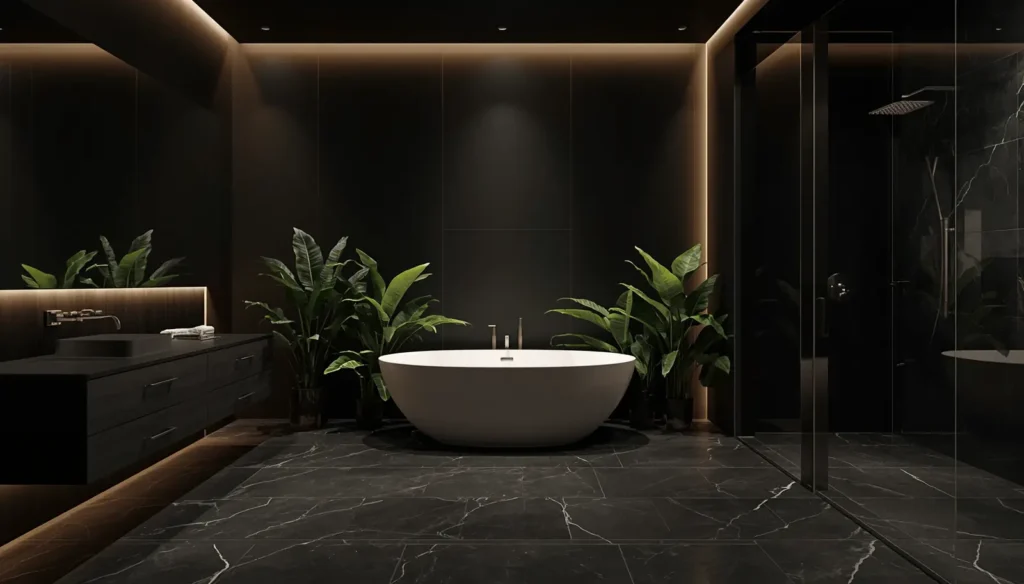
Black bathrooms are everywhere currently, and if you’ve been scrolling Pinterest or flipping through design magazines lately, you already know why. Black bathroom designs have gone from “bold risk” to “must-have look” faster than almost any other trend in recent times. Pinterest flagged dark bathroom aesthetics as one of its top rising home trends going into 2026. Houzz reported that black fixtures were among the most requested upgrades during bathroom renovations last year. That’s not a coincidence — people are tired of safe, forgettable bathrooms. The good news? Black works in almost any space — big or small, rented or owned, budget-friendly or luxury. Here, you’ll find modern bathroom trends 2026 picks, packed with real styling tips and ideas you can start planning today. Matte Black Minimalist Bathroom Minimalist bathrooms work best when every single element earns its place — and matte black makes that easier than any other color. The flat, non-reflective finish hides imperfections, absorbs light beautifully, and gives the room a calm, focused energy. Pair that with a floating vanity, and you’ve got a bathroom that looks like it belongs in an architecture magazine. Design Idea: Hang a large, frameless mirror over a black vanity on a matte-black wall. Tips: Rather than harsh overhead lighting, use warm LED strips behind the vanity for a sense of depth. Clear counter surfaces totally for that true minimalist effect. Best For: Urban apartments and minimalist homes Black Marble Luxury Bathroom Black marble has a natural drama to it that no manufactured tile can fully replicate. Every slab carries its own unique white veining, which means your bathroom ends up being genuinely one of a kind. Paired with brushed gold fixtures, this black marble bathroom looks like it lands somewhere between timeless and jaw-dropping. Design Idea: Cover both walls and floors in full-slab black marble and let the veining do the decorating for you. Tips: Choose brushed gold over chrome — it pulls out the warm tones hiding inside the dark stone. Reseal the marble once a year to keep that deep, rich finish intact. Best For: Master bathrooms and high-end renovations Black and White Contrast Bathroom Black and white bathrooms have been around forever — but the version people are going after in 2026 looks nothing like your grandmother’s checkerboard floor. Geometric patterns, bold veining, and matte black fixtures give this classic pairing a current, intentional edge. And in a smaller bathroom, that strong contrast actually makes the space feel bigger than it is. Design Idea: Lay bold geometric black and white floor tiles, paint or tile walls white, and fit black fixtures throughout for a sharp, cohesive finish. Tips: Always go with dark grout when laying black and white tiles — light grout breaks up the pattern and weakens the whole effect. Add a single black-framed mirror rather than a cluttered gallery wall to keep things clean. Best For: Small to medium bathrooms wanting high visual impact Black Bathroom with Gold Accents If you’ve been browsing black bathroom ideas lately, the black and gold combination keeps showing up — and for good reason. Matte black surfaces and brushed gold hardware sit at opposite ends of the warmth scale, which creates a tension that feels luxurious rather than loud. This is a black and gold bathroom design working at its absolute best. Design Idea: Fit brushed gold faucets, shower systems, and mirror frames against deep matte black walls and cabinetry. Tips: Brushed gold is better than shiny gold; the softer finish ages better and is a great look in photographs. Limit gold touches to three or four signature fixtures, so nothing looks overdone. Best For: Elegant contemporary and Art Deco-inspired homes Black Concrete Bathroom Concrete and black are a natural pairing — both raw, both honest, and both incredibly good-looking when handled with care. A black concrete bathroom with an open shower and hidden LED lighting feels architectural rather than just decorated. The texture in the walls does most of the heavy lifting, so you genuinely don’t need much else. Design Idea: Apply black concrete-finish walls with a floating vanity and a frameless open shower to keep the look sleek and uncluttered. Tips: Recess LED strip lighting into the ceiling or along the floor edge to highlight the concrete texture without flooding the room with harsh light. A matte black basin keeps everything tonally consistent. Best For: Modern industrial and architect-designed interiors Black Bathroom with LED Lighting Most people underestimate how much lighting shapes the way a dark bathroom actually feels. Get it wrong, and the room feels like a dungeon — get it right and it feels like a high-end hotel suite. Warm LED strips under the vanity and behind the mirror are the two changes that make the biggest difference in black bathroom designs. Design Idea: Fit warm white LED strips beneath the floating vanity and recess lighting behind the mirror for a soft, layered glow. Tips: Put everything on a dimmer so you can drop the brightness down in the evenings without reaching for a lamp. Steer clear of cool white bulbs — against black surfaces, they drain all the warmth out of the room fast. Best For: Ultra-modern bathrooms and smart home interiors Black Terrazzo Bathroom Terrazzo flooring went quiet for a few decades and came back stronger than ever — especially in black. The tiny stone and glass chips scattered through a deep black base make every square foot of floor genuinely interesting to look at. It’s a material that rewards you the closer you get to it. Design Idea: Install black terrazzo flooring and keep every other surface in the room simple and plain so the floor gets full attention. Tips: Matte black or clean white walls work best alongside terrazzo — anything patterned on the walls creates visual noise that fights the floor. A wall-hung vanity keeps the terrazzo fully visible and uninterrupted underneath. Best For: Contemporary homes and designer-led bathroom renovations Japandi Black Bathroom Japandi is the kind of design style
Modern Matte Black Bathroom Accessories in India
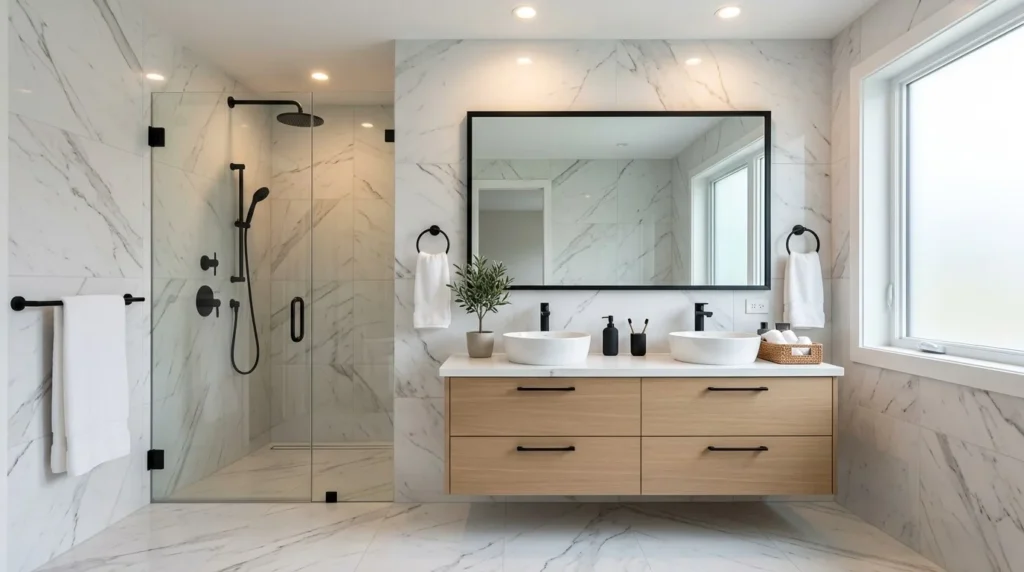
Matte black has become one of the most popular bathroom finishes in India over the last few years. Walk into a new flat in Bengaluru, Pune, or Delhi NCR, and you’ll likely spot a matte black tap or towel bar somewhere. The finish looks calm and a little expensive, without an expensive price tag. It also goes with almost any tile colour, which makes it an easy choice for both new bathrooms and quick upgrades. If you’re planning to bring matte black into your bathroom, this guide covers what to buy, how much it costs in India, and how to style it well. Matte Black Bathroom Accessories Worth Buying You don’t need to change your whole bathroom. A few well-picked pieces can shift the whole look. Matte Black Towel Bar Towel Bar: This is often the first thing you notice in a bathroom. Matte black doesn’t show smudges the way chrome does, and it comes in single, double, and longer 24-inch sizes. Price Range (₹): 800 – 3,500 Matte Black Robe Hook Robe Hook: Small but useful. Go for single, double, or triple hooks depending on how many towels you hang daily. Price Range (₹): 300 – 1,200 Matte Black Soap Dispenser Soap Dispenser: Look for a pump that doesn’t drip or jam. Resin and stainless steel options feel sturdier than plastic ones. Price Range (₹): 350 – 1,800 Matte Black Toothbrush Holder Toothbrush Holder: Ceramic holders are the easiest to clean and feel the most solid on a counter. Families usually do better with 4 to 5 slots. Price Range (₹): 250 – 1,500 Matte Black Toilet Paper Holder Toilet Paper Holder: Open-end styles are easier to load. Covered ones look neater. Most are made from zinc alloy or stainless steel. Price Range (₹): 500 – 2,200 Matte Black Shower Head Shower Head: This is where matte black really stands out, especially against white or light grey tiles. Before buying, check that it works with your building’s water pressure, since this varies a lot across Indian apartments. Price Range (₹): 1,200 – 8,500 Matte Black Faucet Faucet: A single-lever matte black mixer tap is the most popular pick right now. Pillar taps in matte black are also available if you prefer a more classic look. Price Range (₹): 2,500 – 18,000 Matte Black Shower Shelf or Corner Rack Shower Shelf: Corner racks save space and suit smaller Indian bathrooms well. Pick one with a rust-resistant coating, since it stays wet often. Price Range (₹): 600 – 3,000 Matte Black Mirror Frame Mirror Frame: Round and arch-shaped frames are trending in minimal bathrooms right now. Sizes usually range from 18 to 36 inches. Price Range (₹): 1,500 – 9,000 Matte Black Towel Ring Towel Ring: Great for smaller bathrooms where a full bar takes up too much wall space. Most come with all fittings included. Price Range (₹): 400 – 1,800 Matte Black Bathroom Shelf Bathroom Shelf: Useful for candles, skincare, or spare rolls. Floating shelf styles are the easiest to install and look the most current. Price Range (₹): 700 – 4,500 Colour Pairings That Work Well With Matte Black Matte black isn’t picky. It pairs well with a wide range of tile and wall colours, but some combinations feel better than others. How to Choose the Right Pieces of Matt Black Bathroom Accessories Start with the material. Stainless steel with a powder-coated matte black finish holds up best in wet areas like the shower. Zinc alloy works fine for drier spots such as hooks or paper holders, but it can wear faster near constant moisture. Check the finish closely before buying. A good matte black coat looks smooth and even, with no shiny patches or rough spots. Cheap coatings tend to chip within months, especially in humid Indian bathrooms near the coast. A Few More Things to keep in mind: On upkeep, matte black needs a little more care than chrome. Water spots and soap scum do show up, especially with hard water. A soft, damp cloth after use prevents most buildup, and mild soap once a week handles deeper cleaning. Skip steel wool, harsh chemicals, and vinegar-based cleaners, since these strip the coating over time. PVD-coated pieces resist scratches and daily wear far better than painted ones, and they last years longer, even though they cost more upfront. Common Mistakes to Avoid Frequently Asked Questions Does Matte Black Go Out of Style? Unlikely. It’s been a staple in design for decades and only recently became popular in bathrooms. Is Matte Black More Expensive Than Chrome? Usually, yes, by around 20 to 40 percent. The gap shrinks with mid-range brands. Are Matte Black Fittings Suitable for Hard Water Areas in India? Yes, though mineral spots show up more visibly. Wiping down every couple of days keeps this in check. Does Matte Black Scratch Easily? Painted finishes scratch more easily than PVD-coated ones. If your household is rough on fittings, PVD is worth the extra cost. Can Matte Black Rust in Coastal Cities Like Mumbai or Chennai? Lower-quality zinc alloy pieces can, over time, if exposed to salty, humid air. Stainless steel with a proper powder coat holds up much better in these conditions. Can I Mix Matte Black with My Existing Chrome Fittings During a Renovation? You can for a short period, but it’s best to plan a full switch. A mismatched bathroom rarely looks finished, even temporarily. Is Matte Black a Good Choice for Small Bathrooms? Yes, if you keep the number of pieces limited and pick wall-mounted styles. Too many dark pieces in a tiny space can make it feel smaller. Can I Install Matte Black Accessories Myself? Simple items like hooks, rings, and toilet paper holders are easy DIY jobs. Faucets and shower heads usually need a plumber, especially if plumbing lines need adjustment.
Magnifying Mirror vs Vanity Mirror: Which One Do You Actually Need?
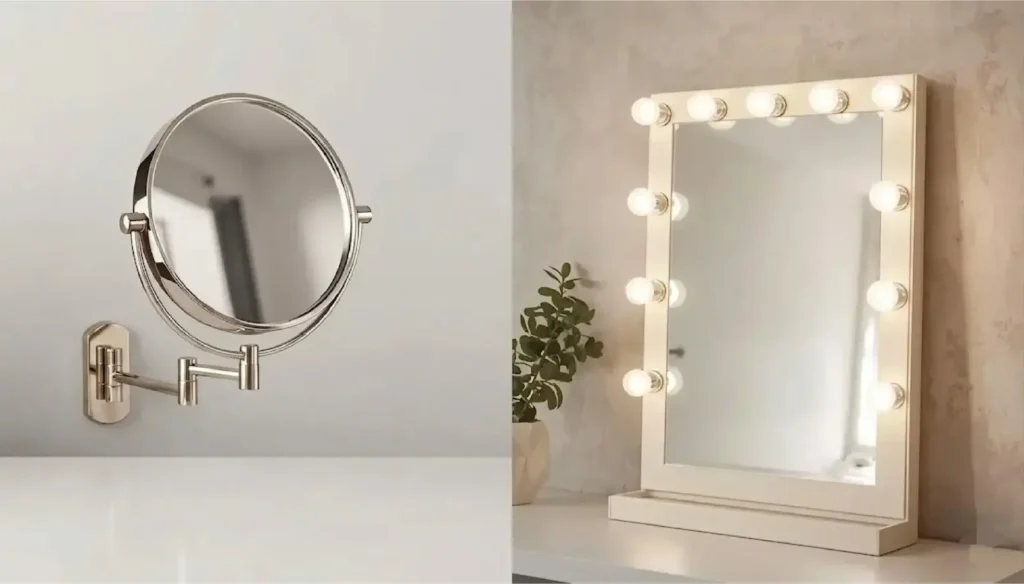
A magnifying mirror zooms in close on your face. A vanity mirror shows your whole face at once, usually with lights. Most people need both, but for different jobs. If you are buying your first mirror for makeup, skincare, or grooming, this guide clears up the confusion in plain terms with real price ranges for the Indian market. Quick Comparison Feature Magnifying Mirror Vanity Mirror Main job Close-up detail work Full-face view Size Small, often 4–8 inches Large, 15 inches and up Zoom 3x to 10x 1x, sometimes with a small zoom panel Lights Optional, small LED ring Common, full LED strip Best for Eyeliner, tweezing, skincare Foundation, hairstyling, outfit checks Price in India ₹300 to ₹3,500 ₹1,200 to ₹15,000+ Space needed Fits on any shelf Needs a table or wall spot What is a Magnifying Mirror? A magnifying mirror uses curved glass to make your face look bigger than it is. This helps you catch small details a normal mirror hides. Common zoom levels are 3x, 5x, 7x, and 10x. A higher number means a closer, bigger view. At 10x, you can see single pores and fine hairs. People buy magnifying mirrors for eyebrow shaping, eyeliner, tweezing, and daily skin checks. Many Indian bathrooms also use a wall-mounted brass magnifying mirror as a fixed second mirror next to the main one, since brass holds up well in humid weather. Example: Begin Faucets sells a Brass Magnifying Mirror (model AC0075) built for exactly this use. It is priced around ₹2,599, down from its listed price of ₹6,500, and suits bathrooms where you want a sturdy metal mirror that won’t rust from steam or splashes. What is a Vanity Mirror? A vanity mirror gives you a clear, full view of your face and upper body. It does not zoom in. It shows you as you actually look. Most vanity mirrors sit on a dressing table or hang on a wall. Many come with built-in LED lights around the frame, which is why they are also called lighted mirrors or Hollywood mirrors. People use vanity mirrors for full makeup looks, hairstyling, and a final outfit check before stepping out. The wide, even light helps you judge how your makeup will look under real daylight. Key Differences Between Magnifying Mirror and Vanity Mirror What Magnification Level is Ideal? 3x – Everyday use and for beginners. 5x – Best all-around for everyday makeup application, like eyeliner or filling in eyebrows. 7x – Suited to tweezing, threading, and closer skincare checks. 10x – For very fine tasks like ingrown hair removal. Can feel too close for regular use. Note: Start with 5x if you are unsure. It gives enough detail without feeling odd to look at. Best Uses for Each Mirror Magnifying Mirror Works Best For Vanity Mirror Works Best For Price Ranges in India Prices vary by size, brand, and lighting. Mirror Type Budget Mid-Range Premium Basic magnifying mirror (no light) ₹300–₹800 ₹800–₹1,800 ₹1,800–₹3,500 LED magnifying mirror ₹900–₹2,000 ₹2,000–₹4,500 ₹4,500–₹8,000 Brass/wall-fixed magnifying mirror ₹1,500–₹2,600 ₹2,600–₹4,000 ₹4,000–₹6,500+ Basic vanity mirror ₹1,200–₹3,000 ₹3,000–₹6,000 ₹6,000–₹10,000 Hollywood-style lighted vanity mirror ₹2,500–₹5,000 ₹5,000–₹9,000 ₹9,000–₹15,000+ Brass and metal-bodied mirrors, like the Begin Faucets AC0075, tend to last longer in Indian bathrooms because they resist rust from humidity and hard water splashes better than plastic frames. Can You Use Both Mirrors Together? Yes, and most beauty experts suggest it. Use the magnifying mirror first for detail work like eyeliner, brows, or spot-checking skin. Then step back and check your full face in the vanity mirror before you finish. This two-step routine catches small mistakes early and still gives you the full picture at the end. How to Choose the Right Mirror Ask yourself these four questions: If your budget allows, buying one of each gives you the most complete routine. Wrapping It Up Neither mirror beats the other. A magnifying mirror wins for precision. A vanity mirror wins for the complete view. Pick based on what your morning routine actually needs, not just looks or price. If you want a mirror that handles both humidity and daily use well, a brass option like the Begin Faucets AC0075 magnifying mirror is a solid, budget-friendly starting point for Indian bathrooms. You can also check the magnifying mirror collections. Frequently Asked Questions Is a Magnifying Mirror Bad for Your Eyes? No, but staring at a 10x mirror for long periods can feel tiring. Use high magnification only for short, focused tasks, not for your whole routine. Can I Mount a Magnifying Mirror Right on My Bathroom Wall? Yes. For this purpose, there are brass or metal wall-fixed magnifying mirrors, for example extendable arm models, which are swung out when needed and folded back against the wall when not in use. Does a Vanity Mirror Need Electricity? Only if it has built-in LED lights. Basic vanity mirrors without lighting need no power source at all. Will a Magnifying Mirror Make My Skin Look Worse Than It Is? It can make small areas like pores or fine lines appear larger to others than they actually are. This is normal and not a sign of bad skin. Use it for precision tasks, not for judging your overall look. What Size Vanity Mirror Suits a Small Indian Bathroom? A mirror between 18 and 24 inches wide usually fits well above a standard washbasin without overcrowding the wall. Do Brass Mirrors Need Special Care? Wipe them with a dry or slightly damp soft cloth. Don’t use harsh chemical cleaners that will dull the brass finish over time. Is a 2-in-1 Mirror, With Both Flat and Magnifying Sides, Worth Buying? Yes, if you are short on space. A double-sided mirror gives you both views without having two separate mirrors, though the magnifying side will usually be smaller than a dedicated one.