A geyser connection pipe is the short pipe that links your water heater to the wall’s shut-off valve (the tap that stops water flow). One pipe carries cold water into the geyser; another carries hot water out to your taps. Choosing the right material and size prevents leaks, burns, and costly repairs.
In this guide, you will learn which pipe materials handle Indian water conditions best, what sizes fit standard geysers, how to install and maintain your pipes, and what to budget for quality fittings.
Types of Geyser Connection Pipes
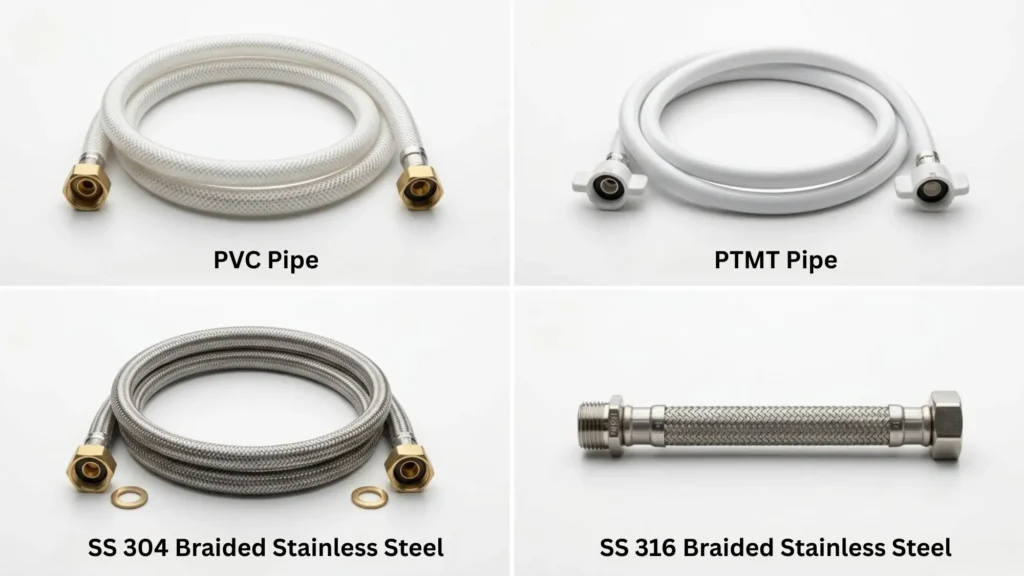
Geyser connection pipe selection is based on the heat resistance, water hardness, and city air.
SS 304 Braided Stainless Steel
SS 304 is the most common choice for the hot water outlet side. It handles temperatures up to 90°C and holds pressure up to roughly 3 bar — well within the range of a standard home geyser.
The “304” refers to the alloy mix: approximately 18% chromium and 8% nickel. That combination creates a tough oxide layer on the surface, which fights rust effectively. But “highly rust-resistant” is not the same as “rust-proof.”
In areas with hard water or mineral-heavy supply, check the fittings every six months for early signs of surface discolouration.
SS 316 Braided Stainless Steel
SS 316 looks identical to SS 304 from the outside. The difference is inside the alloy: SS 316 adds molybdenum (a hardening element that blocks chloride attack — the kind caused by salt in coastal air).
If you live in Mumbai, Chennai, or Kochi, the salt air accelerates corrosion on standard SS 304 fittings. SS 316 handles that environment significantly better and is worth the small price premium in those cities.
PTMT Pipe
PTMT stands for Poly Tetra Methylene Terephthalate, but you don’t need to remember that. What matters is that no metal touches the water path. That eliminates rust entirely and removes the risk of galvanic corrosion (the slow damage that happens when two different metals sit in contact with water).
PTMT is a practical choice for Delhi, Jaipur, Lucknow, and other hard-water cities where mineral deposits accelerate metal wear. It is already the default fitting in many urban apartment buildings across India. The threads are metal-reinforced for a tight seal, so installation is straightforward.
PVC Pipe
PVC is the cheapest option on the shelf. For the cold water inlet side only, it works fine. The problem is temperature: standard PVC softens above roughly 60–65°C, which means it should never go on the hot outlet side of a geyser. A softened PVC joint can bulge, drip, or fail under pressure.
Use PVC only where the water stays cold. If your plumber suggests PVC for the hot side to save money, push back.
| Material | Heat Resistance | Best For | Typical Use-Case |
| SS 304 Braided | Up to 90°C | Hot outlet + cold inlet | Most Indian cities, general residential use |
| SS 316 Braided | Up to 90°C | Hot outlet in coastal areas | Mumbai, Chennai, Kochi, Goa |
| PTMT | Up to 85°C | Hard-water cities, no-rust requirement | Delhi, Jaipur, Lucknow, urban flats |
| PVC | Up to 60°C | Cold inlet only | Budget installs, cold water side only |
Geyser Connection Pipe Size Guide
Before you think about length, check the thread. Nearly all Indian geysers, such as Crompton, Havells, Racold, AO Smith, use a ½ inch BSP thread (British Standard Pipe, the measurement standard used across Indian plumbing). Your geyser connection pipe must match this thread size, or no amount of PTFE tape (thread-seal tape) will stop a slow drip at the joint.
Matching Length to Your Install
The right length depends on one thing: the physical gap between your geyser’s inlet/outlet port and the angle valve (the small shut-off tap fixed to your wall). Here is a quick-pick guide for each standard size:
- 18 inch: The most common choice for standard wall-mounted geysers sitting close to the angle valve; fits most bathroom installs in Indian flats without any excess loop.
- 24 inch: Use this when the geyser is mounted higher than the valve, or when there is a wider gap between the unit and the wall fitting; also, the safest default if you are unsure.
- 30–36 inch: Needed for concealed plumbing (pipes hidden inside walls), overhead-mounted geysers, or commercial setups like hotels and guest houses where the geyser sits farther from the supply point.
The Practical Buying Rule
Measure the distance from the geyser port to the angle valve. Then add 3 inches to that number. That buffer accounts for the angle of the connections, any slight misalignment in the fittings, and the gentle loop you leave in the pipe to absorb thermal expansion (the small amount a pipe stretches when hot water runs through it).
Never buy the exact measured length. A pipe that is even half an inch too short puts stress on both end fittings every time hot water runs, and that stress causes leaks over months, not years.
Quick Tip: If you are unsure which length to buy, pick 24 inch. You can coil the extra length neatly behind the geyser. You cannot stretch a pipe that is too short.
How to Install a Geyser Connection Pipe
Fitting a geyser connection pipe correctly takes under 60 minutes, but skipping any one of these steps can mean a leak, a burnt element, or an electric shock risk.
Step 1: Shut Off Water and Electricity
Turn off the main water supply valve and switch off the geyser’s MCB (the circuit breaker in your electrical panel) before you touch anything. Both must be off — cutting only the water or only the power is not safe enough.
Step 2: Identify the Inlet and Outlet Ports
Find the cold water inlet port (usually at the bottom of the geyser) and the hot water outlet port (usually at the top). Connecting these in reverse sends cold water out to your taps and hot water back into the supply line — a mistake that is easy to make and easy to avoid.
Step 3: Wrap PTFE Tape on Every Male Thread
Wrap PTFE tape (a thin white thread-seal tape that fills microscopic gaps in the joint) 3–4 times clockwise around every male thread end before fitting. Wrapping anticlockwise causes the tape to unwind as you tighten the nut, which defeats its purpose entirely.
Step 4: Insert the Rubber Washer Into Both End Nuts
Drop an EPDM rubber washer (a heat-resistant rubber ring that creates a watertight seal) inside both end nuts before you screw them on. A missing washer is the single most common cause of a slow drip at the fitting joint.
Step 5: Hand-Tighten First, Then Quarter-Turn With a Wrench
Screw both nuts on by hand until snug, then give each exactly a quarter-turn with a spanner. Do not over-tighten SS braided pipes — too much torque cracks the outer stainless steel mesh and weakens the pipe at the very point you are trying to secure.
Step 6: Open the Angle Valve Slowly and Check for Drips
Open the angle valve (the wall shut-off tap) slowly and watch both end fittings for 30–60 seconds. A hairline drip at this stage is far easier to fix now than after the geyser is full and hot.
Step 7: Fill the Tank Completely Before Switching On the Power
Let the tank fill with water completely before you turn the MCB back on. This step is critical. Switching on the electricity before the tank is full runs the heating element dry, which burns it out, a repair that costs far more than the pipe you just fitted.
Why Your Geyser Connection Pipe is Leaking
A leaking geyser connection pipe almost always has one of six causes, and every single one is fixable without calling a plumber, if you catch it early.
1. Missing PTFE Tape or a Skipped Rubber Washer: This is the single most common cause of geyser pipe leaks. The fix is straightforward: drain the pipe, unscrew the leaking end, wrap fresh PTFE tape 3–4 times clockwise on the male thread, and seat a new EPDM rubber washer inside the nut before refitting.
2. PVC Pipe Used on the Hot Outlet Side: Standard PVC cannot handle sustained heat above 60–65°C. Over weeks of daily hot water cycles, the pipe softens at the joint, loses its shape, and begins to weep water. Replace it immediately with an SS 304 braided pipe on the hot side — PVC belongs only on the cold inlet.
3. Over-Tightening the Fittings: One quarter-turn past hand-tight is enough. Forcing the wrench further either cracks the outer SS braid mesh or strips the threads on the brass nut, leaving a gap that no amount of tape will seal. If the nut feels stripped, replace the entire fitting — do not try to re-thread it.
4. Pipe Bought Too Short: A pipe that is even slightly too short pulls at both end fittings every time it flexes under water pressure. That constant angular stress slowly works the joint loose over months. Measure the gap, add 3 inches, and replace the short pipe with the correct length.
5. Thread Mismatch: BSP (British Standard Pipe, used on Indian geysers) and NPT (National Pipe Thread, common on imported units) look nearly identical but have different thread angles. They will never seal against each other properly, no matter how much PTFE tape you add. Check your geyser’s manual for the thread standard and buy a pipe that matches exactly.
Geyser Connection Pipe Price in India
Most buyers are surprised at how much a geyser connection pipe costs. The same 18-inch size will cost you ₹50 or ₹500, depending on the material, brand and where you buy it.
The table below gives you a realistic range to work with before you head to a hardware store or open a shopping app.
| Type | Size | Approx. Pack-of-2 Price Range (₹) |
| PVC | 18 inch | ₹50 – ₹150 |
| PTMT | 18 inch | ₹90 – ₹200 |
| PTMT | 24 inch | ₹120 – ₹250 |
| SS 304 Braided | 18 inch | ₹180 – ₹400 |
| SS 304 Braided | 24 inch | ₹250 – ₹500 |
| SS 316 Braided | 18–24 inch | ₹350 – ₹600 |
SS 316 is less commonly stocked in local hardware shops and is often a special order or online-only purchase.
Why Branded Pipes Cost More and Why It Matters Here
Branded geyser connection pipes typically cost 20–40% more than unbranded ones because they use tighter nut-welding tolerances, stricter pressure testing, and come with a warranty — usually one to three years.
On a cold water tap, a cheap fitting failing means a wet floor; on a hot water line running at 70–80°C, it means a pressurised burst, a potential scald, and water damage to your wall.
Note: Always buy a pack of 2. Every geyser needs one pipe on the cold inlet side and one on the hot outlet side; a single pipe leaves one connection exposed.
When to Replace Your Geyser Connection Pipe: Signs, Lifespan & Care Tips
A geyser connection pipe does not last forever, and the material you chose at installation sets the clock. Here are realistic lifespan estimates under normal Indian household use:
- SS 304 braided: roughly 7–12 years, longer if you are in a low-hardness water zone and inspect the fittings periodically.
- PTMT: roughly 5–8 years. PTMT holds up well against hard water, but the metal-reinforced thread ends can loosen over time with repeated thermal cycling.
- PVC: roughly 2–4 years, and only on the cold inlet side. Heat accelerates degradation significantly, so PVC on the wrong side of the geyser fails much faster.
Signs It Is Time to Replace
Do not wait for a full leak before you act. Replace your pipe if you spot any of these:
- A white mineral crust forming around the nut joint — this is limescale (mineral deposits left behind when hard water evaporates) and signals the seal is already compromised.
- A rusted or discoloured outer braid on an SS pipe — surface rust means the protective chromium layer has been breached.
- A hardened or cracked rubber washer inside the end nut — a washer that has lost its flexibility cannot seal properly, no matter how tightly you fit the nut.
- Persistent dripping that continues even after you re-tighten the fitting — at this point, the thread or the pipe body itself is compromised.
Pro Tip: Replace both pipes together. When one pipe fails, replace the inlet and the outlet pipe at the same time. Both were fitted on the same day, both have been exposed to the same water conditions, and both have aged at roughly the same rate. Replacing only the failed one leaves you with a second replacement job within months.
Final Thoughts
The right pipe comes down to where you live, your water quality, and which side of the geyser you are connecting — match those three, and the rest is straightforward.
For most standard Indian home setups, BeginFaucets’ SS 304 braided connection pipes are a solid place to start; check the sizes and grades they carry before heading to a hardware store.
A well-chosen pipe fits quietly into the wall and does its job for years without demanding anything further.
Frequently Asked Questions
What is the Colour Code for Hot and Cold Water Geyser Connection Pipes?
In most hardware shops across India, you will find these pipes sold in red and blue. Red goes on the hot water side and blue on the cold inlet. It saves a lot of confusion during installation.
Can I Use the Same Connection Pipe for Both the Inlet and the Outlet?
Honestly, no. The outlet side carries much hotter water and deals with higher pressure than the inlet side. Swapping them around or using one pipe for both will wear it out faster and invite leaks sooner than you expect.
Does My Geyser’s Warranty Cover the Connection Pipe?
No, it does not. Brands like Havells, Racold, and Bajaj cover the heating element and the tank — connection pipes are treated as external fittings and are entirely your responsibility to source and maintain separately.
Can I Use a Regular Flexible Hose Instead of a Geyser-Specific Pipe?
That is not a good idea at all. Regular flexible hoses are not built for the heat that comes out of a geyser’s outlet. They tend to swell, crack, or burst within months, leaving you with a leak and a bigger repair bill.
Related Products
Explore products related to this article
-
 25%
25%Pop-Up Brass Waste Coupling 5 Inch | Matte Black
Original price was: ₹950.00.₹715.00Current price is: ₹715.00. Add to cart -
25%
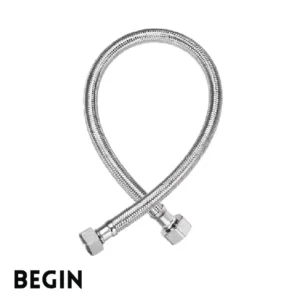
SS Connection Pipe 36 Inch | Stainless Steel | BEGIN
Original price was: ₹566.00.₹425.00Current price is: ₹425.00. Add to cart -
25%
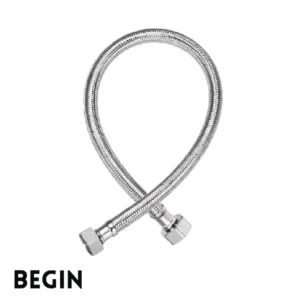
SS Connection Pipe 30 Inch | Stainless Steel
Original price was: ₹466.00.₹350.00Current price is: ₹350.00. Add to cart -
25%
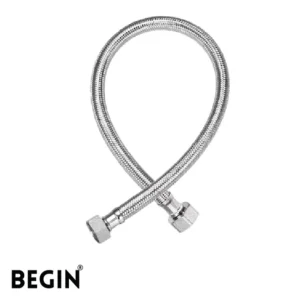
SS Connection Pipe 24 Inch | Stainless Steel
Original price was: ₹317.00.₹238.00Current price is: ₹238.00. Add to cart