A basic shower gets the job done, but a handheld shower head makes it so much better.
A handheld shower head is a flexible, hose-connected shower head you can hold and move freely.
And homeowners love to add one for simple reasons:
- Easier bathing of kids, pets, and elderly family members
- Better rinsing of hard-to-reach places
- More control over water pressure and direction
The best part? You don’t need a plumber. Most people finish this upgrade in under an hour.
In this blog, you will learn exactly how to add a hand held shower head in 7 easy steps. We cover every tool, every part, and every move from start to finish.
Tools and Materials Required
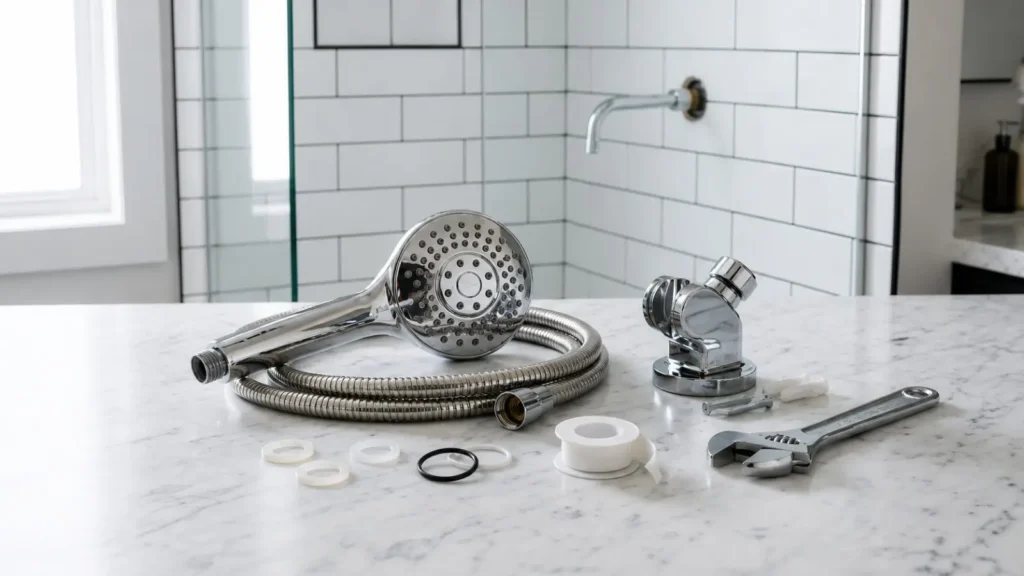
Collect these items before you begin; having everything on hand saves time and prevents trips to the hardware store in the middle of the job.
- Adjustable wrench
- Teflon tape (plumber’s tape)
- Soft cloth or rag
- Handheld shower head kit (with hose and mounting bracket)
Check Your Existing Shower System
Before you begin, check out your current shower to avoid any surprises when you’re working.
1. Most home showers use a ½-inch NPT (National Pipe Thread) connection. This is the standard screw fitting on your shower arm — the pipe sticking out of your wall. Nearly all handheld shower kits fit this size.
2. Your current fixed shower head simply screws off by hand or with a wrench. No special tools needed.
3. But some setups need a diverter valve, a little switch that directs water between two shower heads. You may need one if you want to keep your old shower head running alongside the new handheld unit. More on that in a later step.
4. Most standard bathrooms need zero extra parts beyond the kit itself.
So, check your setup first and shop with confidence.
How to Install a Hand Held Shower Head in 7 Easy Steps
| Difficulty Level | Time Required |
| Easy | 20–60 minutes |
Step 1: Remove the Old Shower Head
Wrap a soft cloth around the base of your old shower head. This stops the wrench from leaving marks on the metal. Grip the cloth-covered base with your adjustable wrench and turn it counterclockwise. Once it starts to move, spin it off the rest of the way with your hand.
Caution: Forcing a stuck shower head too fast can bend the shower arm inside the wall. Work slowly and let the wrench do the job.
Step 2: Clean Off the Old Tape and Inspect the Threads
Use your fingernail or a dry rag to peel off every bit of old plumber’s tape from the shower arm. Old tape leaves behind a gummy layer that stops new tape from sealing well.
After clearing it off, hold the arm near a light source and look at the threads carefully. Smooth, clean threads mean you are ready for the next step.
Pro Tip: Run your fingertip along the threads after wiping them down. Anything that feels rough, raised, or uneven needs a closer look before you go further.
Step 3: Apply New Plumber’s Tape On The Threads
Get the first edge of the plumber’s tape really tight against the bottom of the shower arm threads. Wind the tape around the threads moving in a clockwise direction.
Go around two to three full times, keeping the tape pulled tight the whole way. Press the torn end flat against the threads with your thumb so nothing hangs loose.
Caution: Wrapping the tape in the wrong direction, counterclockwise, makes it unravel the second you screw anything onto it. Always go clockwise.
Step 4: Screw On the Mounting Bracket
Pull the mounting bracket out of your handheld shower head kit. Line it up with the shower arm and begin threading it on by hand. Turn it clockwise and keep going until your hand cannot move it any further. Wrap your cloth around the bracket and tighten it one quarter turn more with the wrench.
Pro Tip: The bracket should face straight out from the wall once tightened. The hose and shower head will hang all weird if it is at an odd angle.
Step 5: Connect the Shower Hose to the Bracket
Take the shower hose from your kit and find the end that fits into the opening of the bracket. Thread the end onto the bottom of the bracket by hand first.
Once hand-tight, hold the bracket steady with one hand and give the hose fitting a short quarter turn with the wrench. Let the hose fall naturally and make sure no section of it is twisted or kinked.
Pro Tip: A twisted hose puts stress on both connection points and shortens the life of the hose significantly.
Step 6: Connect the Hand Held Showerhead to the Hose.
Hold the open end of the shower hose with one hand to keep it steady. Take the handheld shower head and thread it onto the hose end clockwise.
Hand-tighten it until you feel firm resistance. Then use the wrench with the cloth to snug it up one final quarter turn, nothing more.
Pro Tip: Most leaks in a handheld shower head installation happen at this joint. Take your time here and make sure the connection feels solid before testing.
Step 7: Turn the Water On and Look for Leaks
Reach into the shower and turn the water on to full flow. Stand back and watch every connection point for a full minute — the shower arm, the bracket base, and both ends of the hose.
Press a dry fingertip against each joint and check for any moisture at all. Then switch between every spray setting on the handheld shower head to make sure water pressure stays strong and consistent.
Caution: A small drip caught now takes seconds to fix. Left alone, that same drip can damage your wall for weeks and months.
How to Keep Your Existing Shower Head and Add a Handheld One
| Difficulty Level | Time Required |
| Moderate | 30–90 minutes |
The good news is you do not have to choose between your old shower head and a new handheld one. A simple extra part lets you run both.
Using a Diverter Valve
A diverter valve is a small fitting that splits incoming water between two separate outlets — your fixed shower head and your new handheld unit.
- It threads directly onto your shower arm, sitting between the arm and your existing shower head.
- Your handheld shower hose then connects to the second outlet on the valve.
- Most dual shower head combo kits already include a diverter valve inside the box, so check your kit before buying one separately.
Setting Up a Dual Shower System
Once the diverter valve is in place, both shower heads work off the same water line.
- A small toggle or lever on the valve lets you switch water flow between the fixed head, the handheld unit, or both at once.
- Running both heads together will reduce overall water pressure at each one; this is completely normal.
- Position your handheld mounting bracket within comfortable reach so switching between the two feels natural during daily use.
Common Mistakes to Avoid
Small errors during installation lead to big headaches later. Review this table carefully before picking up a single tool.
| Mistake | What Goes Wrong | How to Avoid It |
| Cranking fittings too hard | Plastic connectors crack, and the shower arm threads strip permanently. | Stop at hand-tight and add one firm quarter turn, nothing beyond that. |
| Leaving threads bare without tape. | Water finds the gaps immediately and drips from day one. | Wind plumber’s tape clockwise around every threaded joint before assembly. |
| Rushing through steps out of sequence. | Joints end up misaligned, and the whole setup has to come apart again. | Lock the bracket down first, run the hose second, and attach the shower head last. |
Troubleshooting After Installation
Something not looking right after the water comes on? Work through these fixes one at a time.
Water Dripping From a Connection Point
- Shut the water off and dry every joint with a clean rag before doing anything else.
- Check that your plumber’s tape sits flat against the threads and wraps in a clockwise direction.
- Tighten the dripping joint one quarter turn at a time — stop the moment the drip disappears.
Pro Tip: Never tighten two joints at once. Isolating each one tells you exactly where the real problem lives.
Noticeably Weak Water Flow
- Push the diverter valve toggle firmly to one side — a halfway position splits pressure and weakens both outlets.
- Feel along the entire hose from top to bottom and find any section that bends sharply or folds back on itself.
- Straighten that section out fully and turn the water back on to recheck the pressure.
Hose Tangling or Twisting Constantly
- A short hose runs out of slack fast and starts coiling under daily movement.
- Swap it out for a longer replacement that gives your arm room to move naturally.
- Pick a hose with a swivel connector built into both ends — it spins freely and keeps tangles from forming during every shower.
Final Thoughts
Adding a handheld shower head is well within reach for most homeowners. No special training needed — just the right parts, a little patience, and attention to two things: solid sealing at every joint and a thorough leak test before you call the job done.
Follow each step in order, and the whole project wraps up in under an hour. Once it is in place, the difference in your daily shower routine becomes obvious almost immediately.
More control, more comfort, and a bathroom upgrade that genuinely pays off every single day.
Ready to upgrade your shower?
Browse our full range of handheld shower heads and find the right fit for your bathroom, whether you need a simple swap or a full dual-head setup.
Frequently Asked Questions
Can I Install a Handheld Shower Head in an Apartment?
Most apartments allow it since the swap involves no drilling or permanent plumbing changes. That said, read your lease before touching anything — certain landlords want prior approval even for minor bathroom updates.
How Long do Handheld Shower Head Hoses Last?
A good quality hose typically lasts between three and five years with regular daily use. Stainless steel braided hoses tend to outlast standard plastic ones by a wide margin.
Does Adding a Handheld Shower Head Affect Water Pressure?
A single handheld unit gets full water pressure on its own. Pressure only drops when you run two heads at the same time through a diverter valve setup.
Related Products
Explore products related to this article
-
 25%
25%Overhead Shower 10×10 Square AB3113 | MAZE By Begin
Original price was: ₹1,725.00.₹1,294.00Current price is: ₹1,294.00. Add to cart -
25%
Overhead Shower 10×10 AB3133 – Begin Faucets
Original price was: ₹1,550.00.₹1,163.00Current price is: ₹1,163.00. Add to cart -
25%
Matte Black LED Magnifying Mirror | Premium Bathroom Mirror
Original price was: ₹7,000.00.₹5,250.00Current price is: ₹5,250.00. Add to cart -
25%
Pixel Health Faucet Set AB0153 | Begin Faucets
Original price was: ₹770.00.₹577.00Current price is: ₹577.00. Add to cart